

Table of Contents
Understanding Warehouse Loading Ramps
In today’s fast-paced industrial landscape, the Warehouse Loading Ramp plays a pivotal role in streamlining operations for warehouses across the United States. At Medlin Ramps, with over 35 years in the Material Handling Industry, we recognize these essential tools as sturdy bridges connecting ground level to loading docks, enabling smooth transitions for forklifts and trucks during loading and unloading. This foundational equipment ensures efficient movement of pallets and goods, minimizing downtime in busy commercial settings.
Warehouse loading ramps come in various forms, including the mobile yard ramps understanding for flexible ground-to-dock access and stationary dock ramps designed for permanent installations. These industrial access ramps feature strategic incline angles, often between 12 to 18 degrees, and durable surfaces like serrated steel to provide traction for safe forklift navigation. In manufacturing and logistics industries, they address uneven terrain challenges, supporting load capacities starting at 10,000 lbs to handle heavy cargo without compromising stability. According to OSHA guidelines on powered industrial trucks, stable access is crucial to prevent tipovers; operators must ensure ramps offer secure footing, aligning loads properly to maintain center-of-gravity balance during handling.
Yard ramps, in particular, facilitate quick setup in open yards for trailer loading, while dock ramps integrate seamlessly into fixed dock areas for repeated use. These loading platform bridges enhance safety and productivity by reducing manual labor risks and speeding up workflows, as seen in distribution centers where forklifts traverse ramps to elevate pallets efficiently. MHI industry standards underscore their importance in logistics, promoting reliable connections that comply with best practices for material flow.
As the largest yard ramp manufacturer in the US, we at Medlin Ramps cover the entire USA, one customer at a time, with solutions tailored to diverse needs. This guide delves into the fundamentals of warehouse loading ramps, from customization options to safety protocols and maintenance tips, empowering you to select the right industrial access ramp for your operations. Whether exploring mobile models for versatility or stationary ones for endurance, you’ll gain insights to optimize your warehouse efficiency.
Fundamentals of Warehouse Loading Ramps
Warehouse loading ramps serve as essential infrastructure in industrial settings, enabling efficient and safe material handling by bridging elevation differences between ground level and loading areas. These structures facilitate seamless forklift access to trailers or elevated docks, minimizing downtime and enhancing operational flow in busy warehouses. At Medlin Ramps, with our 35 years in the Material Handling Industry, we emphasize the importance of understanding these fundamentals to select solutions that align with specific needs.
Warehouse loading ramps operate on simple yet effective mechanics, functioning as an industrial loading bridge that connects ground-level operations to higher platforms. The incline allows forklifts to ascend gradually, with surface traction provided by diamond-plate patterns or serrated edges to prevent slippage during transport. According to NIST standards outlined in their Industrial Lifts and Hinged Loading Ramps record, these designs must incorporate precise engineering to handle dynamic loads while maintaining stability. We recommend evaluating the ramp’s incline mechanics, typically set at 12 to 18 degrees for optimal balance between accessibility and safety, ensuring smooth transitions for heavy equipment without excessive strain on machinery or operators.
Common materials for warehouse loading ramps include heavy-duty carbon steel, valued for its superior durability and resistance to wear in demanding environments. This material choice, as validated by NIST engineering specifications, supports long-term performance under repeated use and exposure to varying weather conditions. Standard dimensions often feature lengths of 30 to 40 feet, with widths around 66 to 96 inches to accommodate standard forklifts, providing ample space for maneuvering loads. These sizes allow flexibility in layout planning for operations across US warehouses, where space constraints can vary significantly.
Basic load capacities for warehouse loading ramps start at 10,000 pounds, scaling up based on design to handle typical warehouse payloads without compromise. Safety elements such as integrated guardrails and non-slip surfaces are critical, aligning with OSHA guidelines from their Loading Docks e-Tool, which stress maintaining clear edges and visibility to prevent falls or collisions. OSHA notes that capacities should never exceed rated limits, and we advise consulting manufacturers for site-specific assessments to ensure compliance. For instance, proper traction reduces skidding risks on inclines, protecting workers and cargo alike.
To build a foundational understanding, it is helpful to compare key variations like yard ramps and dock ramps, as these differences directly impact selection for ground-to-dock or portable needs. Such comparisons clarify how each type fits into warehouse workflows, aiding informed decisions on mobility and integration.
| Feature | Yard Ramp | Dock Ramp |
|---|---|---|
| Mobility | Portable and movable | Typically stationary |
| Load Capacity | 10,000-20,000 lbs standard | 15,000-25,000 lbs ground-to-dock |
| Incline Angle | 12-18 degrees | Fixed to dock height |
Data sourced from MHI standards for industrial handling equipment and OSHA guidelines on safe incline and capacity. This comparison highlights the yard ramp’s advantage in flexibility for temporary setups, while dock ramps excel in permanent, high-volume applications. Interpreting these differences, facilities with variable loading points benefit from the mobility of yard ramps, whereas fixed docks suit consistent trailer alignments, optimizing efficiency based on operational demands.
Expanding on these core distinctions, consider how yard ramps support ground access in open yards, often equipped with wheels for repositioning, whereas dock ramps integrate directly with building structures for streamlined trailer loading. This foundational knowledge sets the stage for exploring advanced designs, such as our portable yard ramps and stationary dock solutions at Medlin Ramps. For deeper insights, refer to our loading dock ramps guide.
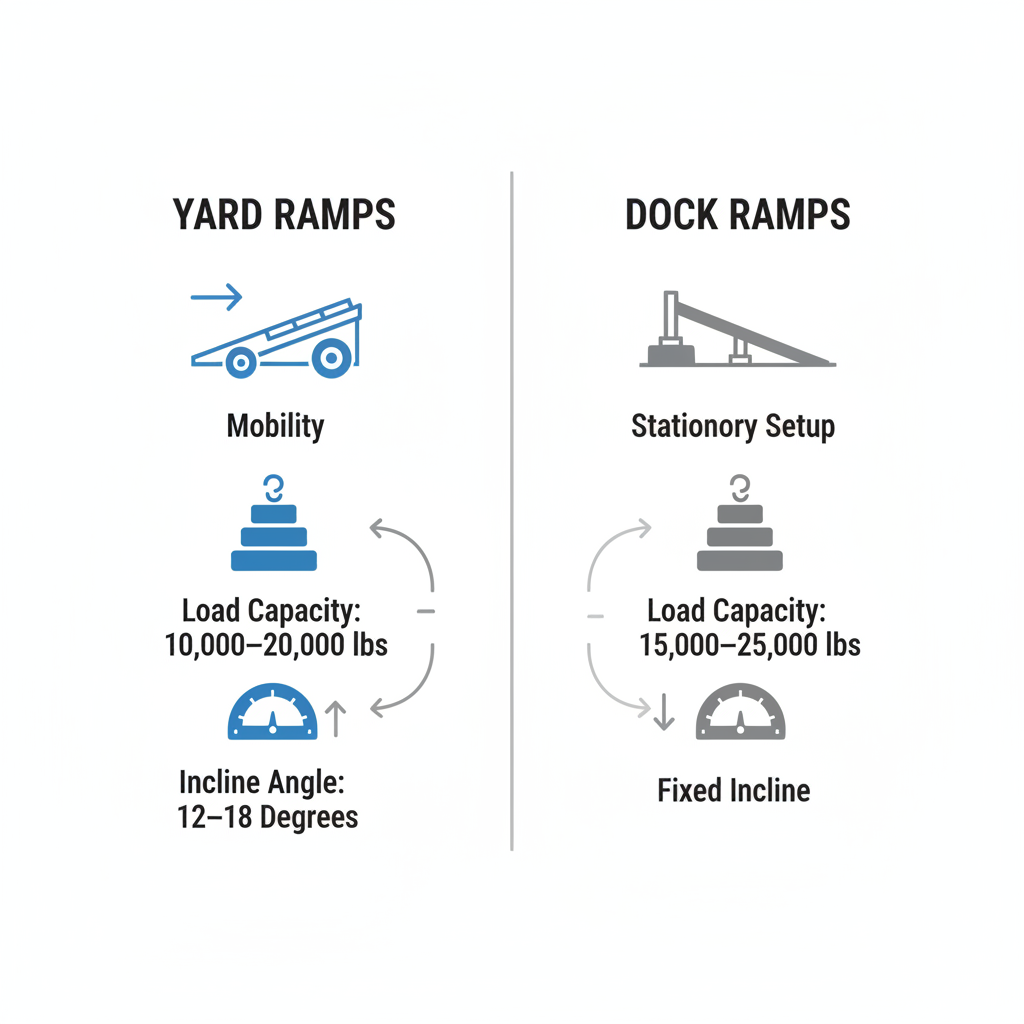
Side-by-side comparison of yard ramps and dock ramps for warehouse loading fundamentals
Do not exceed rated capacities–consult the manufacturer for site-specific load and installation requirements. By grasping these basics, readers can better appreciate how ramps like our carbon steel models enhance safety and productivity in diverse settings.
In-Depth Exploration of Yard and Dock Ramps
From our 35 years in the Material Handling Industry, we have seen how yard and dock ramps transform warehouse operations by facilitating efficient loading and unloading. These essential tools address key challenges in logistics, ensuring seamless integration with forklifts and other equipment. In this section, we explore the mechanics, designs, and customization options that make these ramps indispensable for modern facilities.
Yard Ramp Mechanics and Applications
Yard ramps, often referred to as mobile loading inclines, operate on principles of portability and versatility to bridge ground-level access to truck beds or railcars without requiring permanent dock infrastructure. Their mechanics involve a sturdy frame typically constructed from heavy-duty carbon steel, equipped with a hydraulic or manual lift system for height adjustment. This allows the ramp to align precisely with varying vehicle heights, enabling smooth transitions for forklifts. We recommend models from our Elite Series for high-traffic environments, where the 2-speed manual crank provides reliable elevation control.
In warehouse applications, yard ramps excel in outdoor or multi-bay scenarios where fixed docks are impractical. They support forklift integration by offering wide platforms–up to 96 inches–that accommodate standard pallet jacks and powered industrial trucks. For instance, in distribution centers handling diverse shipments, these ramps reduce downtime by allowing simultaneous loading from multiple trailers. Addressing the question of the best yard ramps for forklifts, our portable designs ensure stable footing with grid-pattern traction, preventing slips during heavy loads. Early adopters in US facilities have reported streamlined workflows, thanks to the mobility that lets teams reposition ramps as needed. The Warehouse Loading Ramp concept underscores this utility, serving as a foundational element in optimizing ground-to-truck transfers.
Safety remains paramount in these operations. Drawing from OSHA guidelines on powered industrial trucks, operators must align the forklift’s load center within the rated 24-inch parameter to avoid tipovers on inclines. We always advise chocking wheels and tilting the mast back slightly for added stability during ascent. Key safety features include anti-slip surfaces and optional side rails, which mitigate fall risks–essential when maneuvering up to 16,000 lbs standard capacities. Regular inspections of hydraulic components further ensure longevity and compliance.
Dock Ramp Design and Efficiency Factors
Dock ramps, or stationary dock bridges, feature robust structures designed for permanent installation at loading bays, providing consistent access to elevated docks. Their engineering emphasizes alignment with truck trailers, using adjustable lips that extend to secure against the dock edge. Constructed from heavy-duty steel, these ramps offer superior durability against constant use, resisting corrosion and wear in demanding environments. The steel’s high tensile strength enhances load distribution, making it ideal for frequent, high-volume operations in manufacturing and shipping.
Efficiency gains come from streamlined loading processes, where the ramp’s fixed positioning eliminates setup time associated with portable alternatives. For example, in retail logistics hubs, Warehouse Dock Ramp installations have improved throughput by allowing uninterrupted forklift traffic. Benefits of steel dock ramps include reduced maintenance needs and enhanced energy efficiency in climate-controlled warehouses, as the seamless bridge minimizes air leakage. Per MHI member resources, such designs support OSHA protocols by incorporating dock boards that secure loads without exceeding vehicle capacities–never more than the forklift’s rated limit.
To answer queries on safety features of heavy-duty loading ramps, dock designs integrate railings at 42 inches high and beveled edges to prevent tripping. Anti-slip coatings on the surface align with OSHA’s emphasis on stable footing, reducing accident risks during wet conditions. We stress training on proper fork placement, ensuring loads remain centered to maintain balance on the incline. These elements collectively boost operational safety and productivity in fixed dock setups.
Customization and Load Capacity Variations
Customization allows yard and dock ramps to adapt to unique warehouse layouts, from tight aisles to high-ceiling facilities. Options include length modifications for optimal incline angles–generally 1:12 ratios for safe forklift navigation–and capacity upgrades to handle specialized loads. Our teams tailor solutions using carbon steel or galvanized finishes, incorporating features like forklift extensions for extended reach. For diverse needs, such as in agribusiness or recycling, we offer rent-to-own programs to test configurations before full commitment.
Load capacities vary from 12,000 lbs for light-duty mobile units to 25,000 lbs for reinforced stationary models, always verified against site-specific requirements. Do not exceed rated capacities–consult the manufacturer for site-specific load and installation requirements. Addressing whether warehouse loading ramps can be customized for specific needs, yes, through adjustable widths and integrated guard rails that comply with OSHA standards for load handling.
Customization needs often differ between portable and fixed installations, influencing choices in length, capacity, and materials. The following table outlines key options:
| Customization Aspect | Yard Ramp Options | Dock Ramp Options |
|---|---|---|
| Length Adjustments | Custom 20-50 ft | Fixed to dock specs |
| Capacity Upgrades | Up to 25,000 lbs | Up to 30,000 lbs reinforced |
| Material Choices | Carbon steel, galvanized | Heavy-duty steel only |
This comparison, based on MHI member resources and OSHA standards for customized loading solutions, highlights yard ramps’ flexibility for dynamic spaces versus dock ramps’ permanence for high-volume docks. Trade-offs include yard ramps’ easier relocation at the cost of slightly lower max capacities, guiding selections for US facilities seeking balanced efficiency and safety.
Practical Applications of Loading Ramps in Warehouses
In warehouse environments, loading ramps serve as essential tools for efficient material handling and safe operations. We at Medlin Ramps emphasize practical implementations that enhance productivity while adhering to industry standards. This section explores installation guidelines, maintenance protocols, and integration strategies to help facilities optimize their setups. By focusing on real-world applications, we provide actionable insights for distribution centers and manufacturing sites across the United States.
Installation and Setup Guidelines
Installing a warehouse loading ramp requires careful planning to ensure safety and functionality. For portable setups, begin with site assessment to identify level ground suitable for the ramp’s base. Position the portable yard ramps near loading areas, using a crane if needed for heavier models. Secure the ramp with wheel chocks and safety chains to prevent movement during use. Next, adjust the height to match the truck bed, typically using a manual crank system for precise alignment. Conduct a load test by driving a forklift across the ramp at reduced speed to verify stability. For stationary dock ramps, start by marking the installation site against the building’s loading dock. Excavate if necessary for a concrete foundation, then anchor the ramp using bolts and welding for permanent fixation. We advise consulting qualified technicians to comply with OSHA guidelines, which stress proper securing to avoid falls or shifts. These steps typically take under an hour for portable options versus one to two days for fixed installations. Always incorporate safety features like guardrails during setup.
The following table compares key aspects of installation methods to aid in selection for everyday warehouse use:
| Aspect | Portable Yard Ramp | Fixed Dock Ramp |
|---|---|---|
| Setup Time | Under 1 hour | Permanent install 1-2 days |
| Tools Required | Minimal (crane optional) | Welding, anchoring |
| Relocation Ease | High mobility | Low, structural |
Choosing between portable and fixed methods depends on operational needs; portable yard ramps offer flexibility for varying truck heights in dynamic environments, while fixed dock ramps provide enduring stability for high-volume facilities. Drawing from OSHA workplace guidelines and NIST records on industrial equipment handling, these differences highlight how portable solutions reduce downtime in relocatable setups, promoting efficiency without compromising safety.
To further illustrate, consider a step-by-step process for portable yard ramps in a distribution center. First, prepare the site by clearing debris and ensuring a firm surface. Second, maneuver the ramp into position using towing capabilities. Third, level and lock the wheels. Fourth, connect safety barriers. Fifth, perform a visual and operational check before initial use. This practical loading solution not only speeds up deployment but also aligns with our commitment to excellence in serving the USA, one customer at a time.
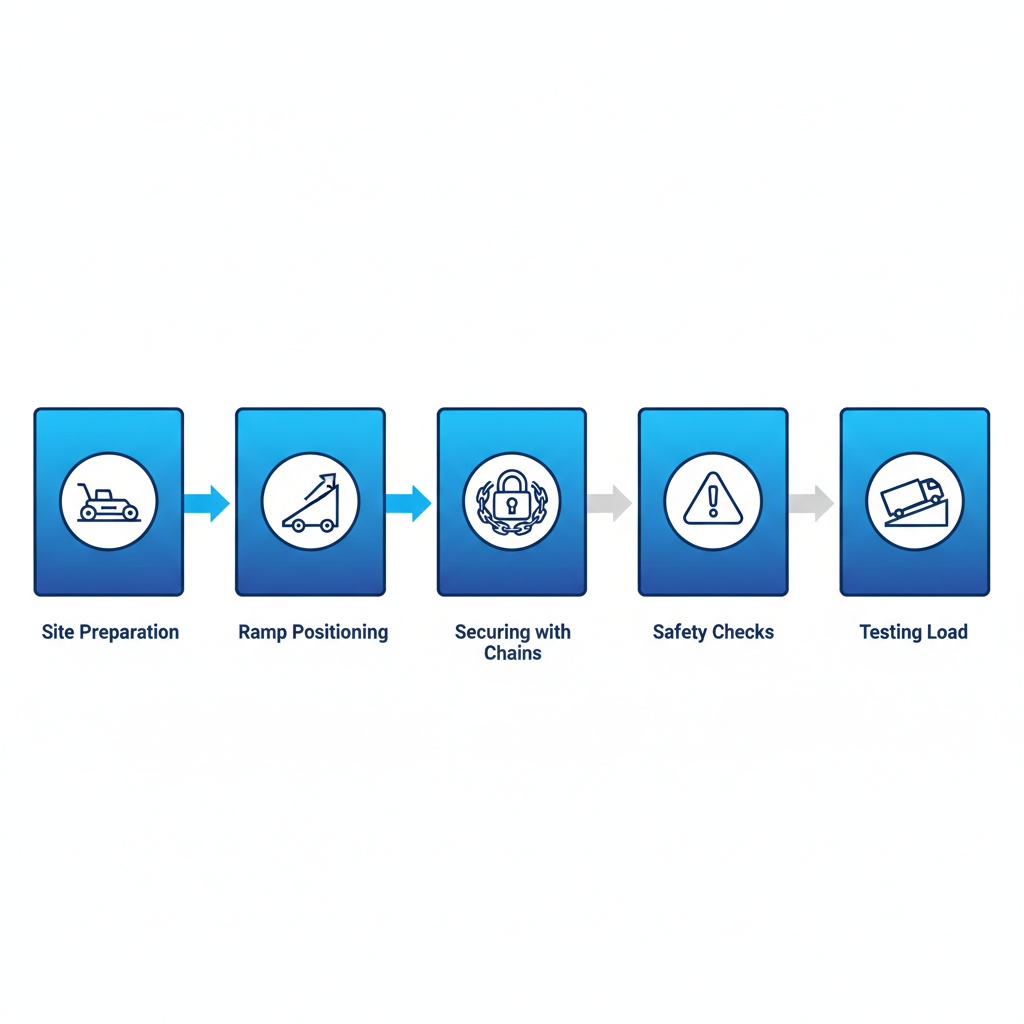
Step-by-step installation guide for portable yard ramps in warehouse settings
Following installation, regular verification ensures long-term reliability, transitioning seamlessly into maintenance practices.
Maintenance Protocols for Longevity
Maintaining dock ramps is crucial for safety and performance in demanding warehouse conditions. We recommend bi-weekly inspections as per OSHA standards to check for structural integrity, focusing on welds, hinges, and support legs for signs of wear or corrosion. For yard ramps, examine the surface grating for debris accumulation that could cause slips, and lubricate pivot points with manufacturer-approved grease to maintain smooth operation. Cleaning involves pressure washing non-slip surfaces quarterly, removing oil spills or residues that degrade traction. Address any dents or bends immediately through professional repairs to uphold load capacities. In distribution centers, where high traffic is common, implement a checklist: 1. Inspect railings for stability; 2. Test height adjustment mechanisms; 3. Verify anchoring points; 4. Document findings in a log for compliance. These protocols extend equipment life, reducing replacement costs and aligning with our 35 years in the material handling industry. Routine upkeep prevents hazards like those outlined in OSHA’s loading docks eTool, such as edge falls, ensuring a safer workspace.
Integration with Forklifts and Trucks
Integrating ramps with forklifts and trucks streamlines warehouse operations. For forklift transitions, align the yard ramp’s lip plate flush with the truck bed to create a seamless bridge, allowing smooth entry and exit. We advise operators to approach at low speeds, centering loads to distribute weight evenly and avoid tipping. In truck alignment scenarios, position the ramp perpendicular to the vehicle for optimal access, using guide markers for precision. This warehouse access tool supports efficient unloading in scenarios like pallet transfers in retail logistics. Best practices from MHI industry groups include visibility enhancements, such as painted edges, to mitigate collision risks during integration.
In high-volume distribution centers, these integrations facilitate faster throughput, though results vary by site-specific factors.
Advanced Considerations for Industrial Ramp Solutions
When managing complex operations in manufacturing and logistics, our facilities often encounter unique challenges that demand sophisticated ramp solutions. We specialize in engineering advanced systems that go beyond standard configurations, ensuring seamless material handling for high-volume environments. These considerations focus on customization, elevated capacities, and compliance, helping businesses optimize their workflows effectively.
For sites with irregular layouts or specialized requirements, bespoke ramp engineering proves essential. A custom warehouse loading ramp can incorporate features like variable inclines or reinforced surfaces tailored to specific forklift models and traffic patterns. Our 35+ years in the material handling industry enable us to design these solutions using durable carbon steel, accommodating everything from tight spatial constraints to extreme weather exposure in facilities across the USA.
Advanced capacities represent a critical upgrade for heavy-duty applications. Standard yard ramps typically handle up to 16,000 lbs, but our custom high-capacity models support loads exceeding 25,000 lbs, as informed by NIST engineering data on industrial lifts. This allows safe transport of oversized pallets or machinery, reducing the need for multiple lifts and minimizing downtime in demanding warehouse settings.
Cost factors significantly influence decisions in ramp procurement. High-quality materials like galvanized steel drive up initial expenses for a heavy-duty loading system, while an advanced access platform may include integrated safety rails or non-slip surfaces that add value over time. Rental options provide flexibility for short-term projects, often costing 10-15% of purchase price annually, versus outright buying which yields long-term savings through ownership and customization. We offer rent-to-own programs to balance these economics, ensuring accessibility for varying budgets.
Facilities facing high-throughput demands benefit from comparing standard and custom options to align with operational goals. The following table outlines key differences in high-capacity ramp solutions, drawing from MHI data on advanced industrial equipment and OSHA guidelines for high-load handling.
| Feature | Standard Capacity Ramp | Custom High-Capacity Ramp |
|---|---|---|
| Max Load | 16,000 lbs | 25,000+ lbs |
| Customization Level | Basic options | Full bespoke design |
| Cost Range | $5,000-$10,000 | $15,000+ |
This comparison highlights how custom ramps, though pricier upfront, deliver superior performance for specialized needs, such as integrating with automated conveyor lines. Selecting the right model depends on load frequency, site specifics, and return on investment, with standard options suiting moderate use while customs excel in intensive scenarios. Always consult manufacturers for site-specific validation to avoid exceeding rated capacities.
Adhering to industry standards remains paramount for dock ramp installations. OSHA guidelines, referenced in NIST CS 202-56, mandate features like guardrails and load-bearing certifications for safe operations, typically requiring widths of 72-96 inches to accommodate standard trucks. MHI standards further emphasize ergonomic designs to prevent injuries, ensuring ramps meet regulatory requirements in US industries without compromising efficiency.
Integration with automated systems elevates productivity further. Our ramps seamlessly connect to robotic arms or sorting mechanisms, enhancing loading dock ramps efficiency through synchronized operations. This approach streamlines workflows in modern warehouses, supporting scalable growth while maintaining compliance.
These advanced elements address common queries on costs ranging from $5,000 to over $15,000, capacities up to 25,000 lbs, and safety integrations, guiding informed decisions for your operations.
Frequently Asked Questions on Warehouse Ramps
We often hear questions about Warehouse Loading Ramp options from customers across the US. Here are answers to common ramp queries.
What is the average cost of a warehouse loading ramp?
Costs vary by type and capacity, typically ranging from $5,000 to $15,000 for standard yard ramps. Custom dock ramps may cost more; contact us for quotes based on your needs.
Can warehouse loading ramps be customized?
Yes, we offer customized yard ramps and dock ramps to fit specific site requirements, including length, width, and capacity adjustments. Our 35 years in the Material Handling Industry ensure tailored solutions.
How much weight can a yard ramp support?
Yard ramps commonly support 12,000 to 20,000 pounds, per MHI standards. Do not exceed rated capacities–consult the manufacturer for site-specific load requirements.
What are the differences between portable dock ramps and fixed ones?
Portable dock ramps provide flexible mobility for varying locations, while fixed dock ramps offer permanent stability. We supply both for efficient loading.
How is installation handled for dock ramps?
Installation requires qualified technicians; we recommend professional setup to ensure safety and compliance with MHI guidelines.
Key Takeaways on Warehouse Loading Solutions
In this loading solution summary, we have explored the fundamentals of warehouse loading ramps, including mobile yard ramps for versatile ground-level access and stationary dock ramps for efficient dock integration. These solutions enhance operational efficiency, improve safety through proper load handling, and support customization to meet specific needs. Regular maintenance ensures longevity and compliance, as emphasized by OSHA guidelines on forklift operations to prevent tipovers and accidents.
We invite you to consider partnering with experts like Medlin Ramps for tailored Warehouse Ramp solutions that align with your operations. Explore our options today to optimize your warehouse productivity without obligation.