

Table of Contents
Understanding Warehouse Dock Ramps
In modern warehousing and distribution centers, a warehouse dock ramp plays a crucial role in facilitating efficient ground-to-dock loading. These robust structures bridge the height gap between trucks and warehouse floors, enabling seamless forklift access and material handling. At Medlin Ramps, with over 35 years in the material handling industry, we understand how these ramps optimize operations in sectors like shipping and manufacturing.
Warehouse dock ramps come in portable or stationary steel designs, each tailored for specific needs. Mobile yard ramps offer flexibility for varying truck heights, while stationary models provide permanent integration with dock levelers for consistent use. Key benefits include reduced loading times by up to 30 percent through faster access, enhanced worker safety via non-slip surfaces, and versatility across industrial applications. Our commitment to excellence is serving the USA one customer at a time, manufacturing high-capacity solutions in facilities across California, New Mexico, North Carolina, and Florida for quick delivery.
As per ANSI MH30.1-2022 standards for dock equipment, reliable designs ensure safe load transfers and durable performance under heavy use. When selecting a Warehouse Loading Ramp, consider factors like capacity ratings, rental options for short-term projects, and built-in safety features such as edge guards. Installation basics involve secure anchoring to prevent shifts, and we offer customization to fit unique site requirements. Dive deeper into costs, capacities, and maintenance in the following sections to make informed decisions for your operations.
Warehouse Dock Ramp Fundamentals
In the fast-paced world of warehousing and distribution, a reliable Warehouse Ramp serves as the essential bridge between ground-level loading and elevated docks, facilitating efficient material handling for forklifts and pallet jacks. These structures enhance workflow in industries like agribusiness, where timely loading of produce or equipment is critical. At Medlin Ramps, with our 35 years in the Material Handling Industry, we understand the foundational role these ramps play in safe and productive operations across the USA.
Warehouse dock ramps come in three primary types to meet diverse loading needs. Mobile yard ramps, often simply called yard ramps, offer portability and flexibility for temporary setups, allowing easy relocation with a forklift. Stationary dock ramps, sometimes referred to as dock levelers, provide a permanent solution anchored directly to the loading dock for high-traffic areas. Portable combos combine elements of both, integrating a ramp with a portable dock for versatile ground-to-dock access. Each type addresses specific scenarios, such as outdoor yard loading or indoor dock integration, ensuring seamless transitions for loads up to several tons.
Understanding the differences between these types helps in selecting the right fit for your facility. For instance, mobile options suit dynamic environments like construction sites, while stationary ones excel in fixed warehouse operations. The following table outlines key attributes to guide your evaluation:
Mobile vs Stationary Warehouse Dock Ramps
| Feature | Mobile Yard Ramp | Stationary Dock Ramp |
|---|---|---|
| Mobility | Portable and relocatable via forklift | Permanently anchored to dock |
| Capacity | Up to 20,000 lbs standard | Higher for heavy-duty applications (50,000 lbs+) |
| Installation Time | Minimal, under 1 hour | Requires concrete bolting (several hours) |
Data for capacities draws from ANSI standards for dock equipment and Medlin Ramps product specifications. Mobile yard ramps provide quick deployment for varying locations, ideal for agribusiness facilities handling seasonal loads, whereas stationary dock ramps offer robust stability for continuous heavy use. We recommend assessing your warehouse’s traffic volume and layout–opt for mobile if flexibility is key, or stationary for enduring performance in high-capacity scenarios. Always consult site-specific needs to avoid exceeding rated limits.
Selecting the appropriate capacity for a warehouse dock ramp involves evaluating your forklift’s weight plus the maximum load it carries. For example, a standard 8,000-pound forklift handling 4,000-pound pallets requires at least a 12,000-pound rated ramp. We advise adding a safety margin of 20-25% to account for dynamic forces during operation. Materials play a crucial role in durability; heavy-duty carbon steel construction, as used in our ramps, resists wear from frequent forklift traffic and harsh weather. Key specifications include:
- Width: 60-84 inches for standard pallet access
- Length: 30-40 feet to achieve optimal incline (10-12 degrees)
- Surface: Serrated for traction, meeting OSHA guidelines
These elements ensure longevity and compliance in demanding environments like distribution centers.
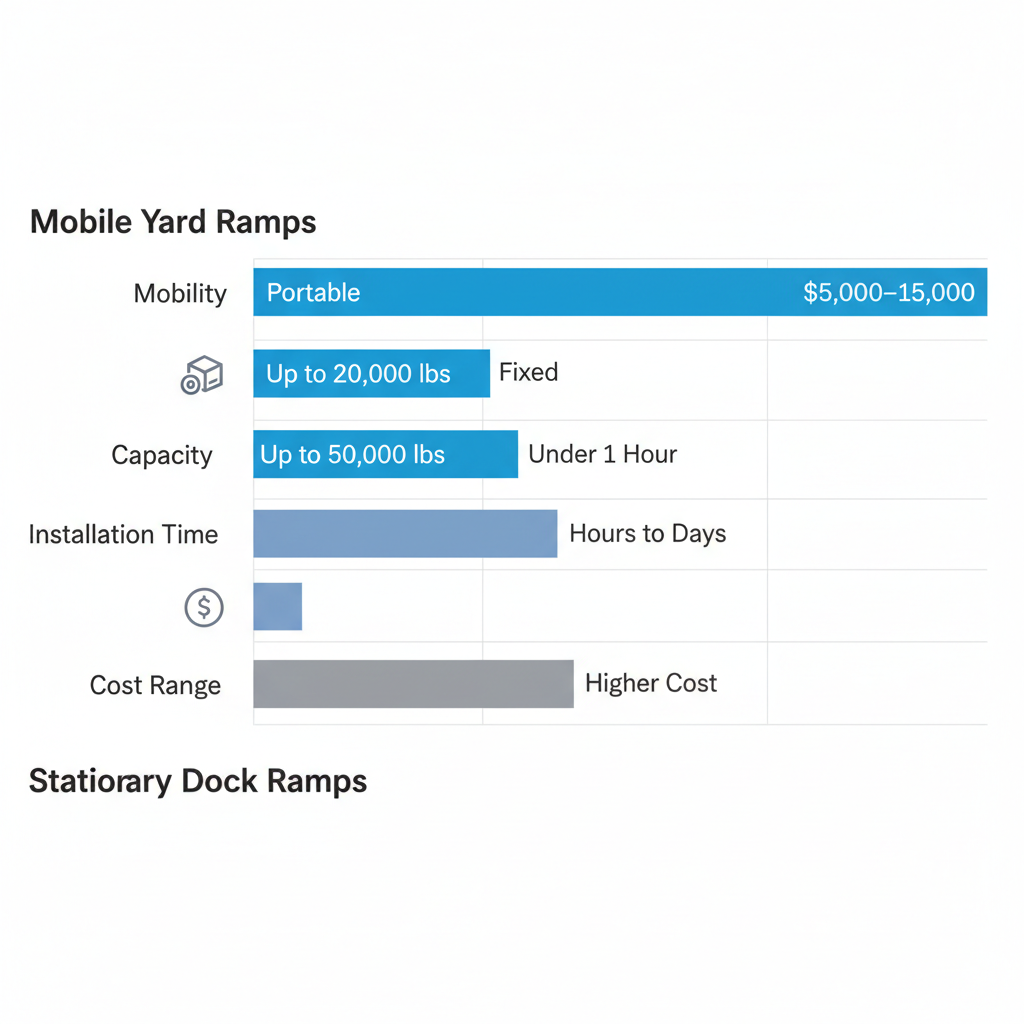
Comparison chart of mobile vs stationary warehouse dock ramps features and capacities
Basic safety features are non-negotiable for any dock access ramp. Anti-slip surfaces prevent skids on wet or oily conditions, while integrated guardrails protect workers from falls, aligning with OSHA loading dock guidelines that emphasize edge protection. Loading platform bridges often include side curbs and maintenance chains for forklift security. Average costs range from $5,000 to $15,000 for standard models, influenced by capacity and customizations–mobile units trend lower due to simpler designs.
For those exploring options, rental programs offer a cost-effective entry point versus outright purchase. Renting a yard ramp allows testing in real operations, with terms starting at short-term needs for peak seasons in agribusiness. Purchasing provides long-term ownership, supported by our rent-to-own plans. Do not exceed rated capacities–consult the manufacturer for site-specific load and installation requirements. This approach balances budget and functionality effectively.
Exploring Warehouse Dock Ramp Features
At Medlin Ramps, with over 35 years in the Material Handling Industry, we engineer warehouse dock ramps to optimize loading operations for high-volume facilities. These essential tools, often referred to as heavy-duty loading bridges, facilitate seamless forklift access platforms between trucks and warehouse floors. Our portable dock ramps offer flexible solutions tailored for industries like retail logistics and aerospace, including clients similar to SpaceX that demand precision and reliability. Key to selecting the right model is understanding distinctions from alternatives like dock levelers, which suit fixed dock setups but lack mobility.
To clarify choices, consider the following comparison based on ANSI MH30 standards and OSHA guidelines for safe material handling.
Yard Ramp vs Dock Leveler Comparison
| Aspect | Yard Ramp | Dock Leveler |
|---|---|---|
| Installation | Portable, no permanent fix | Fixed to dock, hydraulic system required |
| Cost | $5,000-$20,000 | $10,000-$50,000+ plus installation |
| Maintenance | Low, periodic inspections | Higher, hydraulic servicing needed |
| Flexibility | High for varying trucks | Lower, dock-specific |
Yard ramps provide superior adaptability for dynamic warehouse environments where truck heights vary, aligning with MHI guidelines for efficient load handling. This portability reduces setup times, making them ideal for temporary or multi-door operations.
In contrast, dock levelers excel in permanent installations but require more investment. Our yard ramps, however, stand out for their versatility, enabling quick repositioning without specialized tools–perfect for growing operations across the USA.
Safety Enhancements in Warehouse Dock Ramps
Safety remains paramount in warehouse operations, where slips and falls pose significant risks. We design our warehouse dock ramps with anti-slip treads that grip forklift tires and worker boots, even in wet conditions, complying with OSHA 1910.22 standards for walking-working surfaces. Side curbs rise 6-8 inches to prevent accidental roll-offs, while yellow striping along edges enhances visibility for operators navigating tight spaces.
Guardrails on select models offer additional fall protection, crucial for elevated platforms. Lockable wheels on mobile yard ramps ensure stability during loading, preventing unintended movement. These features, informed by OSHA loading dock guidelines, reduce accident rates by promoting clear pathways and secure footing. For instance, in high-traffic aerospace facilities akin to SpaceX, our ramps have supported safe handling of sensitive cargo without incidents. Remember, proper training and adherence to load limits are essential–do not exceed rated capacities.
Overall, integrating these elements creates a robust defense against common hazards, fostering a secure environment for teams.
Capacity and Durability Considerations
Selecting a warehouse dock ramp requires evaluating load capacities to match operational demands. Our models support forklifts up to 15,000 lbs, with 55,000 lb capacity options for heavy-duty use in manufacturing and distribution. Welded steel construction ensures longevity, resisting corrosion and fatigue in demanding settings like recycling or agribusiness.
The 2-speed crank system allows effortless height adjustments, from 36 to 60 inches, accommodating diverse truck beds. This engineering, drawn from ANSI MH30.1-2022 standards, prioritizes structural integrity without compromising mobility. For durability, we use 3/4-inch thick grating that withstands daily impacts, backed by our commitment to serving the USA one customer at a time.
In retail logistics, similar to Home Depot-scale operations, these ramps handle pallet loads efficiently. Rental options provide cost-effective access to high-capacity units, with rent-to-own programs for long-term needs. Always consult us for site-specific validation, as results vary by application. Our multiple facilities in CA, NM, NC, and FL enable faster delivery and lower costs nationwide.
Installation and Setup Processes
Efficient installation maximizes warehouse dock ramp performance from day one. For mobile yard ramps, begin with site preparation: clear a level 10×80-foot area and inspect for obstacles. Position the ramp using a forklift or tow vehicle, aligning the lip with the dock edge.
Next, secure lockable wheels and adjust height via the 2-speed crank until flush. Testing involves a loaded forklift traversal to verify stability–typically completed in 1-2 hours. Tools needed include basic wrenches and safety gear.
Stationary models demand more: anchor bolts secure the base to concrete, following OSHA fall protection protocols. Professional setup, often by certified technicians, takes 4-6 hours, including hydraulic checks if integrated.
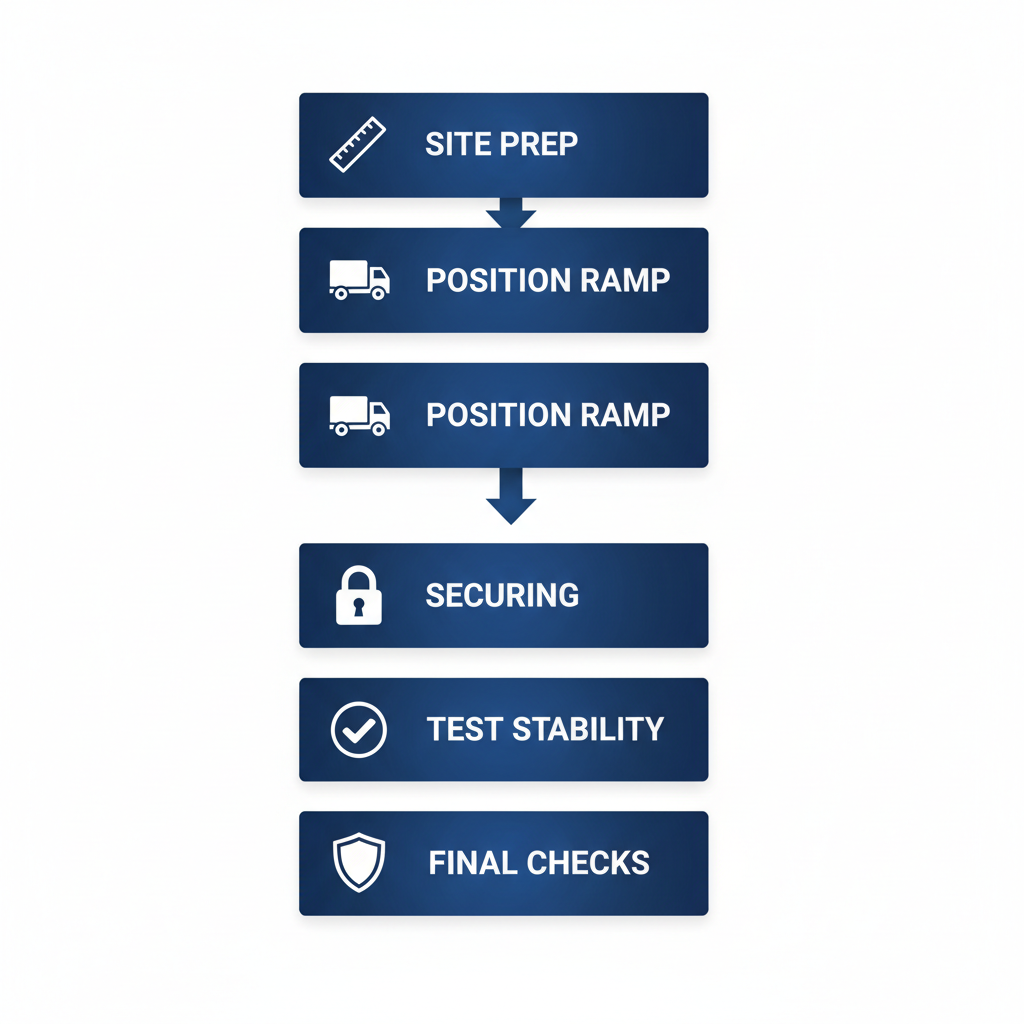
Step-by-step warehouse dock ramp installation process
This visual outlines the sequence, emphasizing safety checks last to confirm compliance. Follow manufacturer instructions and use qualified personnel; improper setup can void warranties. We offer installation support across the US, ensuring seamless integration for your facility. For purchasing or renting yard ramps in the US, contact our team–customer service is king.
Practical Applications of Warehouse Dock Ramps
Warehouse dock ramps serve as essential dock loading solutions for efficient material handling in distribution centers across the US. These warehouse ramp systems bridge ground-level access to elevated docks, enabling seamless forklift operations and optimizing workflow in busy facilities. At Medlin Ramps, we leverage our 35 years in the Material Handling Industry to provide tailored solutions that enhance operational reliability for industrial clients nationwide.
Selecting and Implementing in Warehouses
Selecting the right warehouse dock ramp begins with assessing your facility’s specific needs, including load capacities and forklift specifications. We recommend evaluating the maximum weight your forklifts will carry, typically ranging from 10,000 to 27,000 pounds for standard models, to ensure the ramp’s capacity matches or exceeds these requirements. For instance, a yard ramp with a 20,000-pound rating suits most mid-sized operations, preventing overload risks during daily use.
Site assessment is crucial for successful implementation. Conduct a thorough review of the loading area, considering soil stability, dock height (usually 48 inches), and available space for ramp placement. Mobile yard ramps require minimal site preparation, often just a level gravel base, while stationary options demand concrete footings for permanence. Integration with existing dock systems, such as aligning with dock levelers, ensures smooth transitions and reduces downtime.
Implementation involves straightforward steps: position the ramp using a forklift or crane, secure it with wheel chocks, and test for stability. Mobile units install in 30 to 60 minutes, allowing quick deployment for temporary needs, whereas stationary ramps take 4 to 8 hours with professional setup. We offer guidance on these processes to align with your warehouse layout, promoting safety and efficiency from day one. Always consult our team for site-specific recommendations to avoid common pitfalls like uneven grading.
Industry Examples and Best Practices
In the shipping industry, warehouse dock ramps facilitate rapid loading at facilities like those operated by major retailers such as Home Depot. For example, mobile yard ramps enable ground-to-truck access during peak seasons, reducing wait times by bridging gaps where traditional docks fall short. According to insights from MHI industry groups, such implementations can improve throughput by up to 25% in high-volume environments, validating their role in streamlined logistics.
Agribusiness operations benefit similarly, where dock levelers combined with ramps handle bulk goods like grain or produce. In manufacturing plants, stationary warehouse dock ramps integrate with assembly lines, providing consistent access for heavy machinery transport. A case from MHI resources highlights how a Midwest manufacturer used these systems to enhance material flow, citing reduced injury rates through better ergonomics.
Best practices emphasize regular maintenance to uphold safety compliance. Inspect ramps weekly for weld integrity, surface grip, and hydraulic function, lubricating moving parts as needed. We advise following OSHA guidelines, including non-slip coatings and capacity signage. For longevity, store mobile units undercover and schedule annual professional audits. Training staff on proper usage, such as centered loading and speed limits, minimizes accidents. These steps ensure dock loading solutions remain reliable, supporting diverse applications from recycling centers to retail distribution.
Rental and Purchase Options
We provide flexible renting warehouse ramps options tailored to US industrial needs, including short-term rentals for seasonal demands and long-term rent-to-own programs that transition to ownership over time. Short-term rentals start at monthly fees based on usage duration, ideal for project-based operations, while rent-to-own allows building equity without large upfront commitments. Our purchase process involves customizing selections from our stock series or elite models, with delivery from facilities in CA, NM, NC, and FL for faster nationwide service.
Deciding between rental and purchase depends on operational scale and budget constraints. Factors like projected usage volume and facility expansion plans influence the choice, with MHI LODEM best practices recommending rentals for variable demands to maintain cash flow flexibility.
| Factor | Rental | Purchase |
|---|---|---|
| Upfront Cost | Low, monthly fees | High, $5,000+ (one-time) |
| Flexibility | High for seasonal needs | Lower, permanent ownership |
| Maintenance | Often included | Owner responsibility |
| Long-term Savings | Variable | Yes, better for high volume |
Rentals suit startups or fluctuating operations, offering included maintenance and scalability per MHI guidelines, whereas purchasing excels for established high-volume sites seeking long-term asset control. Contact us to explore terms, as financing is subject to approval. Results vary by application; always verify site needs with our experts.
Advanced Warehouse Dock Ramp Solutions
In today’s demanding logistics environments, a warehouse dock ramp serves as a critical component for efficient loading and unloading operations. At Medlin Ramps, we specialize in advanced solutions that go beyond standard designs, offering customized integrations to meet unique industrial needs. Our loading dock ramps benefits include enhanced safety and productivity, particularly in sectors like recycling where irregular loads are common.
We provide custom loading ramps tailored for unique dock heights and spatial constraints, ensuring seamless ground-to-dock access. These yard ramps incorporate heavy-duty carbon steel construction for durability, with options for forklift extensions that extend reach into trailers. For complex setups, we offer portable dock and ramp combos, fabricated in our U.S. facilities in California, New Mexico, North Carolina, and Florida. This domestic sourcing guarantees quick delivery and compliance with American standards, allowing us to serve clients nationwide with precision-engineered solutions that support high-capacity operations over 35 years in the material handling industry.
Advancing further, dock levelers represent a sophisticated evolution in warehouse accessibility, bridging gaps between vehicles and docks with precision. Developed under standards like ANSI MH30.1-2022, these devices have progressed from basic mechanical aids to automated systems that optimize workflow in heavy-duty settings.
The following table compares key types of hydraulic dock levelers for heavy-duty use:
| Type | Features | Best For |
|---|---|---|
| Mechanical | Manual lift, lower cost | Warehouses with moderate traffic |
| Hydraulic | Automated, self-storing | High-volume distribution centers |
| Air-Powered | Fast operation, energy-efficient | Temperature-controlled facilities |
Integrating these dock levelers with our yard ramps creates advanced dock bridges, enhancing versatility for varying truck heights. For instance, hydraulic models provide smooth transitions that reduce equipment wear, aligning with ANSI specifications for safe load transfers in distribution hubs.
Proper maintenance ensures longevity of dock levelers and ramps, following OSHA guidelines for regular inspections of hydraulic seals and structural integrity. We recommend annual professional servicing to prevent downtime, especially in high-traffic areas. Installation costs typically exceed $10,000, factoring in customization and site preparation, but yield long-term efficiency gains. Results vary by application, so consult our team for site-specific assessments.
Warehouse Dock Ramp FAQ
At Medlin Ramps, with over 35 years in the Material Handling Industry, we address common warehouse dock ramp queries to help streamline your operations. This FAQ covers essentials on costs, capacities, rentals, safety, and more for efficient loading solutions.
What are the typical costs for a warehouse dock ramp?
Warehouse dock ramp costs vary based on size, material, and capacity, typically ranging from $5,000 to $15,000 for standard models. We offer competitive pricing on mobile and stationary options, with custom quotes available upon request. Factors like steel construction and features influence the final price.
What capacities do your yard ramps support?
Our yard ramps handle capacities from 10,000 to 30,000 pounds, designed for heavy-duty forklift traffic. We advise selecting based on your load requirements to ensure safe performance. Exceeding rated capacities is unsafe; consult us for site-specific recommendations.
Do you offer rentals for dock ramps?
Yes, we provide short- and long-term yard ramp rentals, including rent-to-own programs across the USA. Rentals start at affordable daily rates, ideal for temporary needs in warehousing or construction. Contact our team for availability and terms.
How does a dock leveler improve warehouse efficiency?
A dock leveler bridges gaps between trucks and docks, enabling smooth transitions that reduce loading times and forklift downtime. It enhances workflow by accommodating varying trailer heights, boosting overall productivity. We integrate these for seamless operations in distribution centers.
What safety features should a warehouse dock ramp have, per OSHA guidelines?
Essential safety includes non-slip surfaces, side rails, and secure locking mechanisms to prevent accidents, as outlined in OSHA loading dock standards. Regular maintenance ensures compliance and longevity. We prioritize ramp safety info in all designs for worker protection.
Optimizing Warehouse Operations with Dock Ramps
In this industrial ramp overview, the warehouse dock ramp emerges as a vital efficient dock solution for boosting warehouse efficiency. We’ve recapped key fundamentals, including load capacities up to 25,000 pounds and safety features like anti-slip surfaces on yard ramps and dock levelers, ensuring secure operations in distribution and manufacturing settings.
For advanced applications, consider customizable stationary or mobile options. We at Medlin Ramps invite you to consult our experts for tailored needs and explore loading dock ramp selection through rentals or purchases, aligning with MHI standards for material handling excellence.