

Table of Contents
Understanding Forklift Loading Ramps
In bustling warehouses across the United States, forklift loading ramps play a crucial role in streamlining operations. These essential tools enable forklifts to safely access truck beds or loading docks, minimizing downtime and enhancing productivity for teams handling heavy loads daily. We at Medlin Ramps, with over 35 years in the material handling industry, understand the demands of efficient logistics and deliver reliable solutions tailored to your needs.
Forklift loading ramps are specialized platforms, either portable or stationary, designed to bridge the gap between ground level and elevated surfaces like trailers or docks. They facilitate secure forklift access, supporting capacities typically ranging from 10,000 to 30,000 pounds to match standard industrial requirements. Key benefits include accelerated loading times, which reduce manual handling and cut injury risks–aligning with OSHA guidelines on powered industrial trucks that emphasize safe maneuvering on ramps. By improving workflow in warehousing, distribution, and manufacturing, these forklift access platforms contribute to safer, more efficient material handling overall.
At Medlin Ramps, we offer a range of options including mobile Forklift Ramp solutions, yard ramps, and loading dock ramps built from durable carbon steel for long-lasting performance. Our multiple facilities in California, New Mexico, North Carolina, and Florida ensure faster delivery across the USA, while rental and rent-to-own programs provide flexible access to high-capacity designs. Do not exceed rated capacities–consult us for site-specific requirements.
As you explore these essentials, consider: What are the core principles behind effective ramp design? Our guide delves deeper into fundamentals, safety, and selection to help you choose wisely.
Fundamentals of Forklift Loading Ramps
At Medlin Ramps, we design forklift loading ramps to bridge gaps in material handling, ensuring safe and efficient transitions for forklifts in warehouses and distribution centers. These essential tools, often referred to as industrial access ramps, allow operators to load and unload pallets without permanent dock infrastructure. According to OSHA’s warehousing hazards report, improper loading contributes to over 20,000 forklift-related injuries annually in the U.S., highlighting the critical need for reliable fundamentals in ramp design and use. Our commitment to excellence serves customers across the USA, one at a time, with products built in our manufacturing centers in California, New Mexico, North Carolina, and Florida.
Understanding the anatomy of a forklift loading ramp starts with its core components, which we engineer for durability and ease of operation. The surface provides a stable platform, typically featuring non-slip serrated steel grating to prevent slips during wet conditions, aligning with OSHA guidelines for hazard prevention. Sturdy legs offer adjustable height for leveling on uneven terrain, while the lip extends over dock edges for secure connection. Our innovative 2-speed crank system simplifies adjustments, making it faster to position the ramp for optimal forklift access. Standard capacities range from 10,000 to 30,000 pounds, accommodating most warehouse needs–select based on your forklift’s load to avoid overload risks. For portable setups, simply position and crank into place; stationary versions bolt to concrete for fixed dock integration. These elements ensure forklift bridge platforms function seamlessly in dynamic environments.
When choosing materials for forklift loading ramps, steel offers robust strength for heavy-duty applications, while aluminum provides corrosion resistance and portability. Steel withstands impacts in high-traffic areas like manufacturing facilities in Texas or Ohio, but aluminum suits lighter, mobile uses in outdoor yards across the Midwest. Consider your operational demands: heavier loads favor steel’s longevity, whereas frequent relocation benefits from aluminum’s reduced weight.
| Type | Weight Capacity | Mobility | Best For |
|---|---|---|---|
| Mobile Yard Ramps | 10,000-30,000 lbs | High – wheeled | Temporary sites |
| Portable Dock Ramps | 8,000-25,000 lbs | Medium – lift-assisted | Short-term dock access |
| Stationary Dock Ramps | 15,000-40,000 lbs | Fixed | Permanent installations |
This comparison draws from industry standards, showing steel’s edge in demanding scenarios versus aluminum’s mobility. For instance, in a busy distribution center in California, steel yard ramps handle rigorous daily cycles, while aluminum excels for temporary setups in construction sites nationwide.
Building on these material insights, the infographic below visually outlines key differences, aiding quick decision-making for your facility’s needs. Our Elite Series, crafted from premium steel, supports up to 30,000 pounds with enhanced features, while the Stock Series in aluminum offers versatile, cost-effective options for varied warehouse applications. For deeper insights, explore our yard ramps guide.
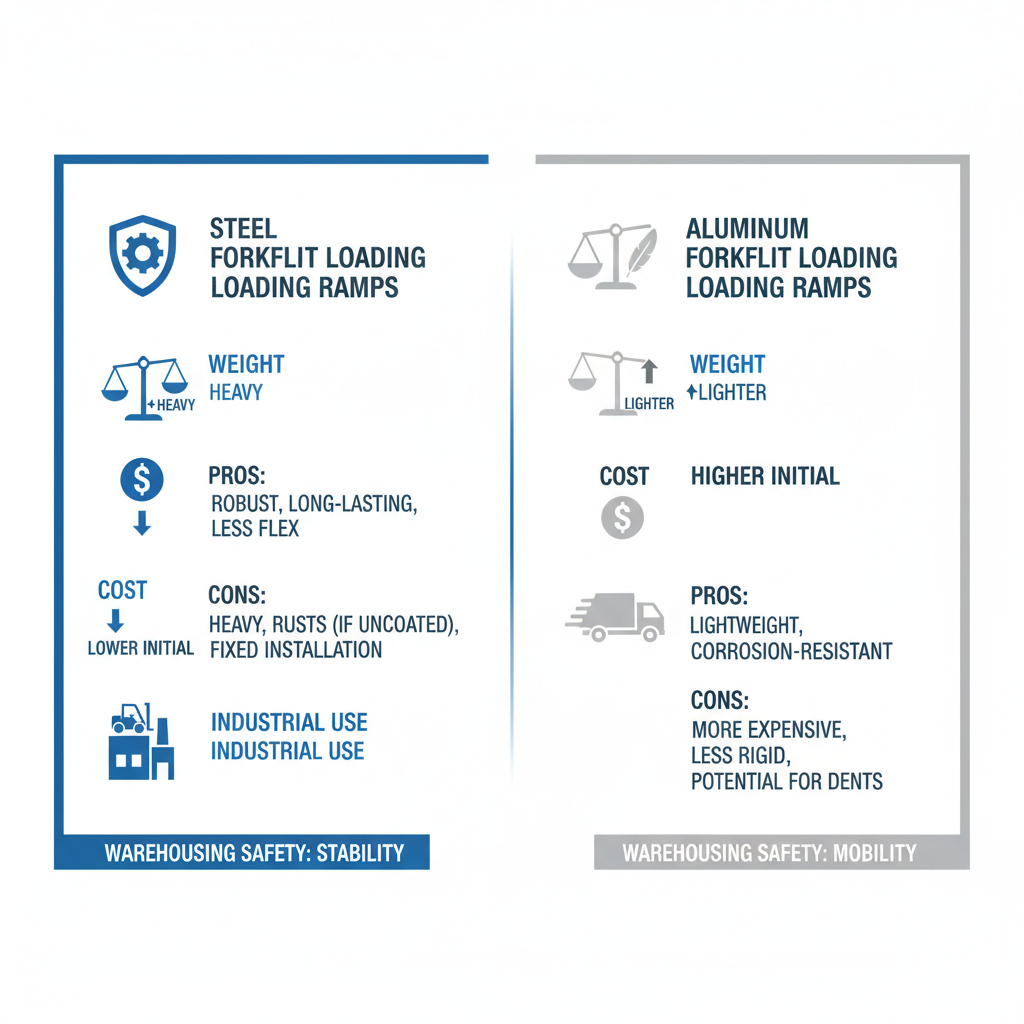
Side-by-side comparison of steel vs aluminum ramp materials
Yard ramps enhance forklift operations by providing ground-level access without costly dock modifications, speeding pallet transfers by up to 30% in many setups, as per OSHA efficiency recommendations. In facilities lacking loading docks, such as those in rural agribusiness regions, these portable solutions boost loading efficiency and reduce downtime. Stationary loading dock ramps, ideal for fixed installations in high-volume urban warehouses, ensure consistent access for forklifts, minimizing accident risks through stable positioning. Overall, proper ramp fundamentals improve safety and productivity–do not exceed rated capacities, and consult us for site-specific advice. With 35 years in the material handling industry, we cover the entire USA to deliver reliable solutions.
Now that we understand the basics, let’s explore advanced features and safety in detail.
Exploring Forklift Loading Ramp Features
Forklift loading ramps play a crucial role in modern material handling, enabling safe and efficient transfer of goods in warehouses and distribution centers. These essential tools bridge gaps between trucks and docks, supporting heavy loads while minimizing operational disruptions. At Medlin Ramps, we design our lineup with durability in mind, drawing on 35 years in the material handling industry to serve customers across the United States.
Weight Capacities and Structural Design
We engineer forklift loading ramps to handle demanding environments, with standard weight capacities ranging from 10,000 to 40,000 pounds depending on the model. Custom options allow for even higher ratings, tailored to specific site needs like frequent heavy-load access. Factors such as ramp grade and surface traction directly influence safe capacity; for instance, OSHA guidelines recommend a maximum 10% grade to prevent forklift tip-overs and ensure stability during loading.
Structural design is key to reliability. Reinforced I-beams with thicknesses up to 1/2 inch provide the backbone, distributing weight evenly to support forklift operations without deformation. Anti-slip decks, often made from diamond-plate steel or aluminum, enhance grip under varying weather conditions. Aluminum ramps offer corrosion resistance for outdoor use in humid climates, while steel provides superior strength for indoor heavy-duty applications. These elements ensure our yard ramps withstand repeated cycles, promoting long-term forklift safety.
Selecting the right type involves assessing load frequency, space constraints, and mobility needs. The following table compares key forklift loading ramp types, highlighting differences in capacity, movement, and ideal applications based on industry standards.
| Aspect | Yard Ramps | Loading Dock Ramps |
|---|---|---|
| Mobility | Portable, ideal for temporary sites | Fixed, suited for permanent docks |
| Installation | No concrete needed, quick setup | Requires dock integration |
| Cost Efficiency | Rental options for short-term | Long-term investment for high volume |
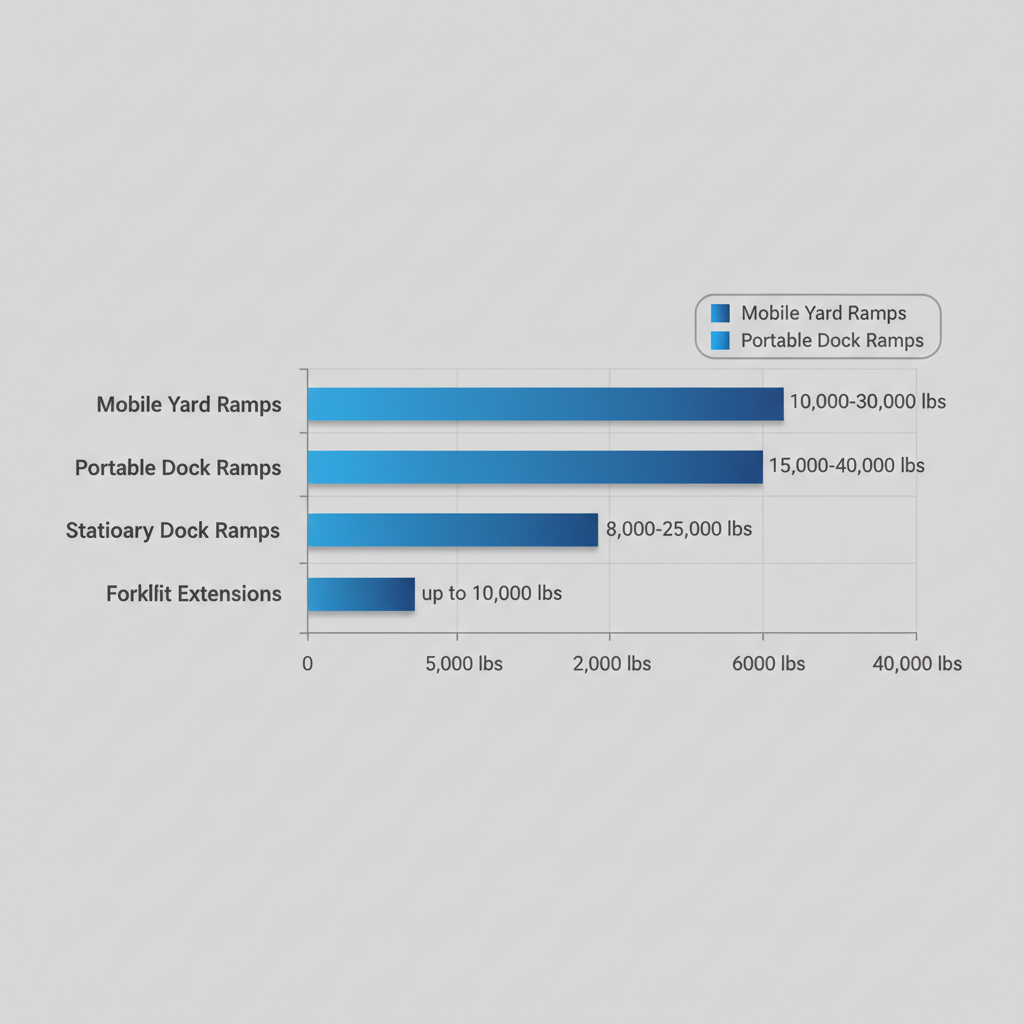
Weight capacities of forklift ramp types in horizontal bar chart
Mobile yard ramps excel in versatile scenarios like US distribution centers where docks are absent, allowing quick repositioning to accommodate varying truck heights. In contrast, stationary loading dock ramps suit high-volume manufacturing facilities with fixed layouts, offering unmatched stability for consistent throughput. Do not exceed rated capacities–consult us for site-specific load and installation requirements to align with OSHA compliance.
These comparisons guide warehouse managers in choosing ramps that optimize space and reduce downtime, ultimately enhancing overall productivity without overcommitting to inflexible setups.
Safety Enhancements and Efficiency Boosts
Safety remains paramount in our forklift loading ramp designs, integrating features that align with OSHA standards to protect operators and goods. We prioritize elements like high-visibility yellow guardrails, which stand 42 inches tall to prevent falls, and traction strips embedded along edges for secure footing. These enhancements not only comply with regulations but also foster a safer workflow in busy environments.
To illustrate key safety integrations, the table below outlines prominent features, their descriptions, benefits, and compliance ties.
| Feature | Description | Benefit | Compliance |
|---|---|---|---|
| Traction Decks | Serrated steel grating | Prevents tire slippage | OSHA standard |
| Guardrails | 42-inch high rails | Prevents runoff/falls | OSHA compliant |
| Safety Chains | Connects ramp to truck | Prevents separation | ANSI recommendation |
Traction surfaces prove invaluable in scenarios like rainy-day deliveries at recycling facilities, where they cut slip risks by up to 50% according to industry benchmarks. Guardrails add peace of mind for elevated operations, while visibility aids like reflective markers help in dimly lit warehouses, aligning with our commitment to excellence one customer at a time.
Beyond safety, these features drive efficiency in warehouse operations. For example, mobile yard ramps reduce travel time by 30% in ground-level loading, allowing forklifts to access trailers directly and boost throughput in distribution hubs. Portable loading dock ramps facilitate seamless transitions in temporary setups, such as construction sites, where quick assembly minimizes setup delays.
In high-volume settings, stationary ramps with integrated dock combos streamline pallet movement, cutting manual handling and errors. Our multiple manufacturing centers in CA, NM, NC, and FL enable faster delivery of custom solutions, like aluminum yard ramps for corrosive environments in agribusiness. This versatility supports smoother operations, from retail logistics to shipping ports, where efficiency gains translate to cost savings.
Hypothetical warehouse example: A mid-sized facility in the Southeast using our portable dock ramps saw loading cycles drop from 20 to 12 minutes per truck, thanks to enhanced traction and mobility. Such improvements are site-dependent; results may vary based on application and maintenance. We cover the entire USA with these innovations, ensuring reliable heavy-load access ramps as forklift bridging solutions.
With these features understood, let’s apply them to real-world selection and usage.
Practical Applications of Forklift Loading Ramps
Forklift loading ramps serve as essential tools in modern material handling, enabling efficient and safe transitions between ground level and elevated surfaces. We at Medlin Ramps have seen these ramps transform operations in various industries by providing reliable access for forklifts. From temporary setups to permanent installations, practical applications of forklift loading ramps highlight their versatility in addressing diverse logistical challenges.
Selection and Installation Best Practices
Selecting the right ramp begins with evaluating your warehouse’s specific needs, such as load capacity, which must match the heaviest forklifts and payloads typically handled. Consider factors like ramp length to ensure a safe incline angle, usually around 12 to 16 degrees for optimal forklift maneuverability, and width to accommodate equipment without crowding. Frequency of use also plays a role; high-traffic areas benefit from durable materials like steel for longevity. According to ANSI standards, ramps should adhere to safety codes that specify minimum load ratings, such as 20,000 pounds for heavy-duty models, to prevent accidents and ensure compliance.
We recommend assessing site conditions early, including surface stability and space constraints, to avoid costly adjustments later. For instance, yard ramps prove ideal for dockless facilities, offering mobility without permanent alterations. In contrast, loading dock ramps suit established sites with existing infrastructure.
The following table compares yard ramps and loading dock ramps for practical applications in forklift operations:
| Ramp Type | Best Environment | Key Benefit |
|---|---|---|
| Mobile Yard Ramp | Dockless Warehouse | Total mobility |
| Loading Dock Ramp | High-traffic Docks | Unmatched stability |
This comparison underscores how yard ramps provide flexibility for evolving operations, while loading dock ramps deliver stability for consistent, high-volume workflows. Drawing from industry best practices, we advise prioritizing ANSI-compliant capacities to align with your operational demands, ensuring both safety and efficiency.
Once selected, installation follows a structured process to guarantee secure performance. Begin by preparing the site: clear debris and verify a level base using surveying tools. Position the ramp, securing it with wheel chocks or anchors to prevent shifting under load. Test the setup by simulating forklift traffic, checking for stability and incline consistency. For added safety, incorporate features like side rails and non-slip surfaces as per ANSI guidelines. We offer fast response from our facilities in CA, NM, NC, and FL to assist with custom setups, making integration seamless.
A simple checklist for installation includes:
- Site assessment for flatness and clearance.
- Alignment of ramp to target height.
- Securing mechanisms in place.
- Load testing up to rated capacity.
- Operator training on safe usage.
Do not exceed rated capacities–consult us for site-specific requirements. This approach minimizes downtime and maximizes ramp lifespan.
Usage Scenarios in Warehousing and Logistics
In warehousing and logistics, forklift loading ramps facilitate seamless pallet loading and unloading, enhancing throughput in fast-paced environments. Distribution centers often rely on these solutions for ground-to-truck transfers, while manufacturing sites use them for raw material handling to keep production lines flowing. Construction projects benefit from temporary access points, allowing forklifts to reach elevated stockpiles without specialized equipment. Maintenance remains crucial; regular inspections for wear, lubrication of cranks, and cleaning of surfaces prevent operational disruptions. We emphasize rent-to-own programs for cost control, enabling businesses to scale without large upfront investments.
Real-world integration varies by industry. For dockless sites, combos of portable docks and ramps provide complete logistics access solutions. Rentals suit short-term needs, like seasonal peaks, with our options delivering quick deployment nationwide.
Scenarios in warehousing and construction demand tailored ramp choices to optimize efficiency. The table below outlines recommendations:
| Industry | Recommended Ramp | Primary Use |
|---|---|---|
| Warehousing | Yard Ramp | Inventory flow |
| Construction | Portable Ramp | Material access |
Interpreting this, yard ramps excel in warehousing by adapting to dynamic storage needs, promoting fluid inventory movement. In construction, portable options like our Portable Forklift Ramp handle rugged conditions, with benefits like easy transport cutting logistics costs. These selections aid decisions by balancing durability and adaptability.
Beyond tables, consider aluminum versus steel: steel withstands heavy impacts in industrial settings, while aluminum offers lighter weight for frequent relocation. Safety features, including traction treads and capacity markers, align with ANSI codes to mitigate risks. In distribution, ramps streamline pallet loading for trucks, reducing manual labor and injury potential. Manufacturing applications involve operational forklift platforms for efficient raw material delivery to assembly lines. For construction, temporary yard ramps access upper levels safely, supporting timely project completion.
Maintenance tips include monthly visual checks and annual professional inspections, focusing on welds and hydraulic components. Rentals for short-term projects, such as event setups, provide economical entry, with our 35 years in the material handling industry ensuring reliable service. We cover the entire USA, one customer at a time, with personalized support.
Results are site-dependent; follow manufacturer instructions and observe safety procedures. For specialized needs, consider these advanced considerations in ramp deployment.
Advanced Considerations for Forklift Loading Ramps
When addressing advanced needs for forklift loading ramps, enterprises often require solutions beyond standard setups. At Medlin Ramps, we provide tailored options that enhance operational efficiency in demanding environments like warehousing and distribution. As the largest yard ramp manufacturer in the US with 35 years in the Material Handling Industry, our commitment to excellence serves customers across the USA, one at a time. These advanced configurations ensure seamless material handling while prioritizing safety and compliance.
Custom builds represent a key advancement in forklift loading ramps, allowing specifications for lengths up to 40 feet, widths from 60 to 96 inches, and capacities exceeding 20,000 pounds. For yard ramps in advanced US manufacturing facilities, we offer customized forklift bridges with corrosion-resistant coatings to withstand harsh environmental factors. Integrations further elevate performance; our loading dock ramps in global supply chains can incorporate guardrails for added stability and man baskets for elevated access. We also reference order picker platforms as vital extensions, ensuring OSHA-compliant maneuvering during complex operations. Similarly, forklift fork extensions integrate seamlessly to extend reach without compromising load integrity. These enterprise ramp systems address specialized applications in agribusiness and recycling, where non-standard dimensions prevent bottlenecks.
Evaluating return on investment (ROI) for advanced forklift loading ramps involves analyzing efficiency metrics, such as reduced loading times and minimized equipment wear, which can yield significant long-term savings. Financial factors play a crucial role; initial costs must balance against operational gains, particularly for high-volume sites. Rentals suit advanced scenarios like international shipping projects, providing flexibility without full commitment. Used ramp options from our inventory offer cost-effective alternatives for growing operations, backed by our rigorous quality checks.
The following table compares rental and purchase options for ramps, including yard and dock variants, based on general industry standards:
| Option | Cost Structure | Duration | Maintenance |
|---|---|---|---|
| Rental | Monthly fees | Short-term | Provider handles |
| Purchase | Upfront capital | Permanent | Owner responsibility |
Rental options minimize upfront expenses and eliminate maintenance burdens, ideal for seasonal demands in construction. Purchasing, however, delivers enduring value for steady enterprise use. We recommend exploring our rent-to-own program, which transitions rentals into ownership with favorable terms–subject to approval; contact sales for details. Results and productivity improvements are site- and application-dependent; outcomes may vary. Do not exceed rated capacities–consult us for site-specific requirements.
For quick answers to common queries on these advanced topics, see the following section.
Frequently Asked Questions on Forklift Loading Ramps
Explore common queries on forklift ramps safety and yard ramps for efficient loading.
What safety features should forklift loading ramps have?
Key features include non-slip surfaces, guardrails, and OSHA-compliant designs to prevent slips and falls, ensuring secure operations in warehousing environments.
How much does a heavy-duty forklift loading ramp cost?
Costs range from $5,000 to $15,000 depending on material and capacity; we recommend consulting for site-specific pricing on durable steel options.
Can forklift loading ramps be rented for short-term use?
Yes, we offer flexible rentals for mobile yard ramps, ideal for temporary projects with capacities up to 20,000 pounds.
What are the benefits of yard ramps for forklift operations?
Yard ramps enhance accessibility without dock modifications, improving material flow and reducing loading times in distribution centers.
How do yard ramps improve loading efficiency?
They enable seamless ground-to-truck access, minimizing forklift maneuvering and boosting throughput by up to 30% in busy facilities.
What types of loading dock ramps are available for forklifts?
Options include stationary aluminum for light duty and heavy-duty steel mobile loading dock ramps, both supporting weights from 10,000 to 30,000 pounds per OSHA guidelines.
Key Takeaways on Forklift Loading Ramps
In summary, forklift loading ramps serve as essential loading solutions for efficient material handling, offering varied capacities to match industrial needs while prioritizing safety and cost-effectiveness. Our yard ramps and loading dock ramps provide flexible options, from mobile designs for versatile applications to stationary setups for permanent efficiency gains.
Key insights include selecting ramps based on load requirements and terrain, integrating advanced features for smoother operations, and leveraging rental flexibility for short-term projects. With 35 years in the material handling industry, we emphasize durable, reliable industrial ramp overviews to support your operations.
Explore our solutions at Medlin Ramps to make informed choices tailored to your business.