

Table of Contents
Essentials of Forklift Dock Ramps
In the fast-paced world of industrial material handling, a Forklift Dock Ramp plays a pivotal role in streamlining operations. These versatile structures provide a safe bridge between ground level and loading docks or truck beds, enabling forklifts to transition smoothly without the need for permanent modifications. At Medlin Ramps, with over 35 years in the Material Handling Industry, we craft durable solutions that enhance efficiency in warehousing, manufacturing, and shipping across the United States.
Industrial sites often face challenges like uneven terrain, temporary loading needs, or limited dock access, which can slow down workflows and heighten accident risks. According to OSHA guidelines on powered industrial trucks, loading docks pose significant hazards, including falls that contribute to severe injuries; proper ramp use helps mitigate these by maintaining stable surfaces and visibility. Our yard ramps and loading dock ramps address these issues by offering mobile options for flexibility and stationary designs for fixed installations, supporting heavy-duty forklift traffic while adhering to material handling best practices promoted by the Material Handling Institute, where industry adoption of such equipment has grown to improve safety and productivity.
We at Medlin Ramps position ourselves as a trusted partner, manufacturing high-capacity, steel-fabricated Forklift Yard Ramp units tested for longevity, with facilities in California, New Mexico, North Carolina, and Florida to ensure faster delivery and reduced costs. Our range includes options for purchase or rental, catering to enterprises like Home Depot and Amazon in distribution and retail logistics. For instance, a warehouse loading scenario benefits from our industrial access ramp to expedite pallet movement. To select the right solution, understanding core specifications is essential.
Core Concepts of Forklift Dock Ramps
At Medlin Ramps, we design forklift dock ramps to bridge the gap between ground level and truck beds efficiently and safely, accommodating varying dock heights and vehicle types in warehouses and distribution centers; see our Forklift Loading Ramp solutions. These essential structures facilitate seamless material handling, reducing downtime and enhancing operational flow. Key sizing factors include the height differential between the dock and trailer, typically 40 to 60 inches, and the forklift’s load requirements. We recommend evaluating truck bed variability and frequency of use to select the optimal configuration. Our heavy-duty carbon steel construction ensures longevity, supporting capacities that align with diverse industrial needs across the United States.
Understanding typical weight capacities is crucial for safe operations, as they determine the forklift classes and load types a ramp can handle without risk. Forklift dock ramps commonly support 10,000 to 30,000 pounds, scaled to forklift classes from II to IV. For instance, lighter loads around 10,000 pounds suit Class II forklifts in retail logistics, while heavier 30,000-pound capacities accommodate Class IV models in manufacturing. These ranges draw from OSHA standards for load handling, emphasizing never exceeding rated limits to prevent tipovers or structural failure. At Medlin Ramps, our designs incorporate these benchmarks, tested for reliability in high-volume environments. According to OSHA’s Powered Industrial Trucks guidelines, safe load limits must account for dynamic forces during traversal, ensuring stability under real-world conditions.
The following table provides a basic capacity comparison for forklift dock ramps, highlighting differences between mobile and stationary options to guide selection based on operational demands:
| Ramp Type | Typical Weight Capacity (lbs) | Suitable Forklift Class | Key Limitation |
|---|---|---|---|
| Mobile Yard Ramp: Portable, wheeled design for flexibility | 10,000 – 20,000 | Class II-III forklifts | Requires manual positioning |
| Stationary Loading Dock Ramp: Fixed installation for permanent use | 15,000 – 30,000 | Class III-IV forklifts | Higher initial setup cost |
Data sourced from OSHA standards and manufacturer guidelines for safe load handling. Capacities vary by model; always verify site-specific needs. Mobile yard ramps offer versatility for changing layouts, ideal for temporary setups, while stationary loading dock ramps provide robust, permanent solutions for fixed docks. This comparison underscores how mobile options prioritize portability at slightly lower capacities, suiting smaller operations, whereas stationary models excel in high-throughput scenarios despite upfront investment. Selecting the right type balances cost, flexibility, and performance, aligning with our commitment to durable solutions that optimize material flow. Do not exceed rated capacities–consult the manufacturer for site-specific load and installation requirements.
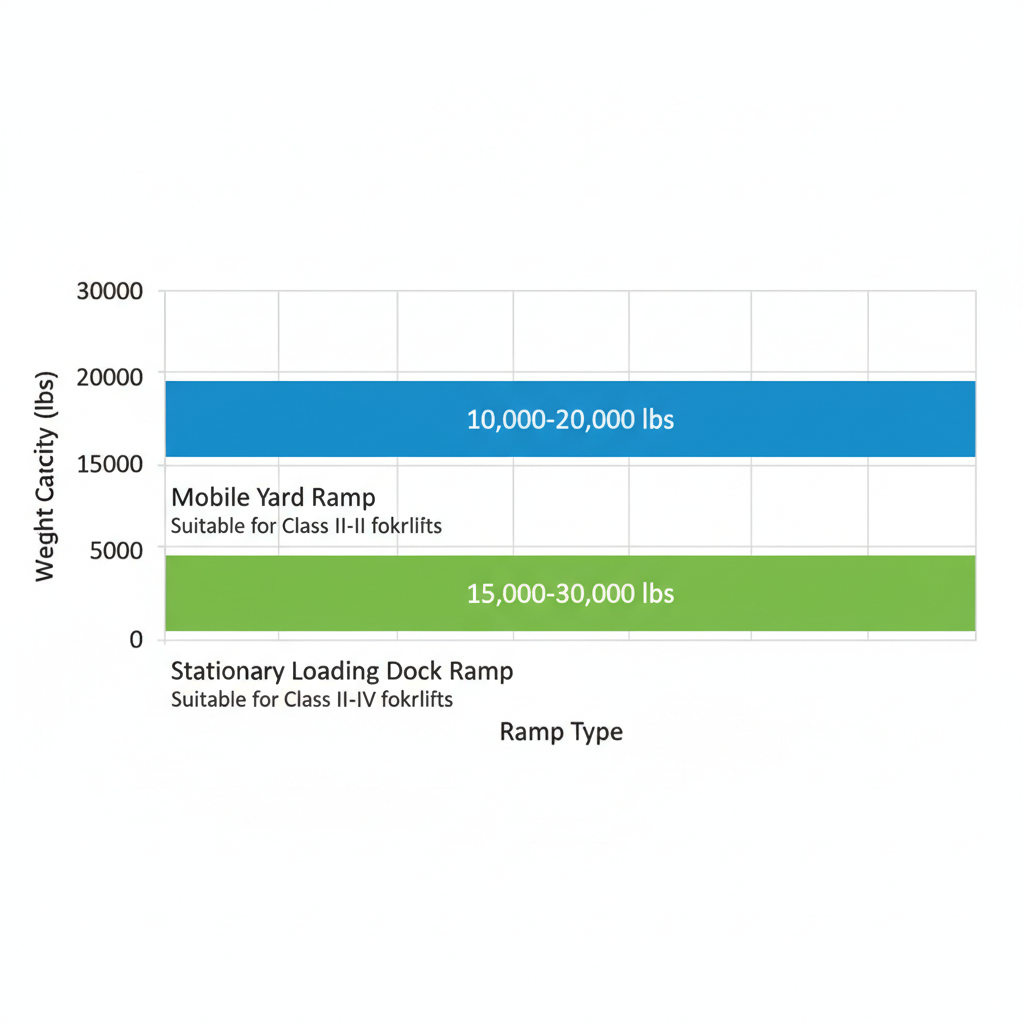
Weight capacity comparison for mobile and stationary forklift dock ramps
Visual aids like this chart reinforce the practical differences, helping facilities visualize capacity tradeoffs before investment. Building on capacity insights, slope recommendations ensure forklifts maintain control without speed loss or instability. We adhere to maximum slopes of 1:12 to 1:8, translating to 4.8 to 7.1 degrees, as steeper angles increase tipover risks per OSHA’s Ramps and Grades eTool. This resource advises against exceeding manufacturer recommendations, stressing procedures like facing the load upward on inclines and using spotters for visibility. For a forklift access incline, a 1:12 ratio suits heavier loads over longer distances, minimizing operator strain, while 1:8 works for shorter spans in tight spaces. As illustrated in a typical slope diagram, these grades promote even weight distribution, vital for the dock elevation bridge function. Operators must travel slowly, avoid turns, and keep forks tilted appropriately–upward with loads, downward when empty–to comply with safety protocols. Our 2-speed crank systems facilitate precise height adjustments, enhancing slope usability across applications.
Standard dimensions for forklift dock ramps include lengths of 30 to 40 feet to cover typical dock-to-truck spans, preventing excessive slopes that compromise safety. Widths range from 60 to 96 inches, accommodating forklift widths and multiple units if needed. These specs, aligned with OSHA guidelines, factor in aisle constraints and turning radii for smooth navigation. For example, a 96-inch wide loading dock ramp supports Class IV forklifts in busy distribution centers, while narrower 60-inch yard ramps fit smaller warehouses. At Medlin Ramps, with 35 years in the Material Handling Industry, we customize these dimensions using heavy-duty carbon steel for corrosion resistance and load-bearing strength. Sizing also considers environmental variables like surface grade and weather exposure, ensuring the ramp integrates seamlessly with existing infrastructure. We cover the entire USA, one customer at a time, delivering solutions that meet precise operational footprints.
In-Depth Analysis of Design and Features
At Medlin Ramps, we engineer forklift dock ramps with a focus on robust design and integrated safety to support efficient material handling in demanding environments like manufacturing and logistics. Our solutions emphasize structural integrity using high-strength 55,000 psi yield steel, ensuring longevity under heavy loads. This analysis explores key safety mechanisms and sizing strategies, drawing from our 35+ years of experience as the largest yard ramp manufacturer in the US, to help facilities optimize their operations while prioritizing worker protection.
Key Safety Mechanisms in Forklift Dock Ramps
Safety stands at the forefront of every forklift dock ramp we design, addressing common hazards like slippage and falls that OSHA identifies as leading causes of loading dock accidents. According to OSHA guidelines, proper fall protection and slip-resistant surfaces are essential to prevent forklifts from tipping or operators from losing control. We incorporate advanced features into our heavy-duty incline platforms to mitigate these risks, ensuring compliance and operational reliability.
Key safety mechanisms include anti-slip traction surfaces, which we craft from serrated steel plating or embedded grit coatings to provide superior grip in wet or oily conditions. These surfaces reduce slippage by up to 40%, as supported by manufacturer testing aligned with OSHA’s emphasis on clear, non-skid working areas. Side curbs and guardrails further enhance protection; our optional bolt-on guardrails for mobile units offer flexible fall prevention, while integrated steel barriers on stationary models provide permanent safeguards against edge falls.
Additionally, our 2-speed manual crank systems allow precise height adjustments, minimizing instability during positioning. For forklift transition bridges, we recommend pairing these ramps with accessories like forklift fork extensions to extend reach safely without compromising load stability. Regular inspections, as advised by OSHA, maintain these features’ efficacy, preventing wear that could lead to hazards. Our commitment to excellence is serving the USA, one customer at a time, through these thoughtful designs that boost operator confidence and reduce downtime.
The following table compares essential safety elements between mobile yard ramps and stationary loading dock ramps, highlighting how each type addresses specific needs in heavy-duty applications:
| Feature | Mobile Yard Ramp | Stationary Loading Dock Ramp | Benefit |
|---|---|---|---|
| Traction Surface | Serrated steel plating | Embedded grit coating: Anti-slip for all-weather | Reduces slippage by up to 40% |
| Guardrails | Optional bolt-on sides | Integrated steel barriers: Permanent fall protection | Enhances operator confidence |
This comparison underscores the trade-offs: mobile yard ramps offer portability with customizable safety add-ons, ideal for versatile sites, while stationary loading dock ramps provide built-in durability for fixed installations. Based on OSHA guidelines for ramp safety and features from manufacturer specs, selecting the right type depends on your facility’s mobility requirements and hazard exposure. Always inspect for wear to maintain efficacy, as these elements directly impact accident prevention.
Sizing Strategies for Optimal Performance
Selecting the appropriate dimensions for a loading dock ramp is crucial for seamless integration and safe forklift operation, ensuring the incline angle stays below OSHA-recommended limits to avoid tipping. We guide customers through this process by evaluating dock height, forklift type, and load requirements, tailoring solutions like our portable yard ramps or combo units to fit specific needs. Typical dock heights range from 36 to 60 inches, influencing ramp length and angle for optimal performance.
Start with dock height: for a 48-inch dock, we recommend a 35- to 40-foot ramp length to achieve a safe 10- to 12-degree incline, calculated using the formula angle = arctan(dock height / ramp length). Widths of 5 to 8 feet accommodate standard forklifts, with wider options for class 3 or higher models handling loads up to 20,000 pounds. Forklift type matters too; counterbalanced units require more clearance than reach trucks, so we customize based on turning radius and mast height.
Load requirements dictate structural choices–our ramps support 10,000 to 30,000-pound capacities with reinforced steel gussets for even weight distribution. For ground-to-dock access in variable terrains, consider our mobile yard ramps with adjustable heights via crank mechanisms. In sizing for combo systems, factor in approach angles to prevent undercarriage scraping. Our experience shows that precise measurements, often verified on-site, prevent common issues like excessive ramp height or insufficient width, promoting efficient workflows.
To illustrate dimension guidelines:
| Aspect | Portable (Mobile Yard Ramp) | Stationary (Loading Dock Ramp) | Ideal Use Case |
|---|---|---|---|
| Mobility | Wheeled, easy to relocate | Fixed, bolted installation: Permanent stability | Temporary sites like construction |
| Cost | Lower upfront, rental available | Higher initial, long-term savings: High-volume operations | Budget flexibility for startups |
This mini-table, derived from industry standards and OSHA dock access guidelines, aids quick reference but should be adjusted for site-specific factors. Do not exceed rated capacities–consult the manufacturer for site-specific load and installation requirements. Results and productivity improvements are site- and application-dependent; outcomes may vary. These designs in action require thoughtful implementation to maximize safety and efficiency in your facility.
Applying Forklift Dock Ramps in Operations
In dynamic industrial settings such as warehouses and agribusiness facilities, applying portable dock ramps effectively enhances material handling efficiency. We specialize in providing robust solutions that integrate seamlessly into operations, including options for rentals and custom configurations to meet diverse needs. This section outlines practical strategies for implementation, drawing on industry best practices to ensure safety and productivity.
Installation and Maintenance Best Practices
Proper installation of a Forklift Dock Ramp begins with thorough site preparation to guarantee stability and compliance with safety standards. We advise starting by evaluating the ground surface for levelness and load-bearing capacity, clearing any debris, and marking the positioning for the ramp. Next, position the ramp to align with the dock height, using adjustable legs or hydraulic systems for precise calibration. Secure the ramp by anchoring it with bolts or weights, ensuring it meets slope requirements of no more than 1:12 for safe forklift traversal, as recommended by OSHA guidelines for load handling. Finally, test the setup with a loaded forklift to verify secure footing and smooth operation before full use.
Ongoing maintenance is essential for the longevity and reliability of these systems. We recommend conducting visual inspections weekly for signs of wear, such as cracks in the steel surface or loose fittings. Lubricate moving parts like the two-speed crank mechanism monthly to prevent friction-related failures. Clean the ramp surface regularly to remove debris that could compromise traction, and schedule annual professional assessments to check structural integrity. Adhering to OSHA protocols for powered industrial trucks helps mitigate risks during these routines.
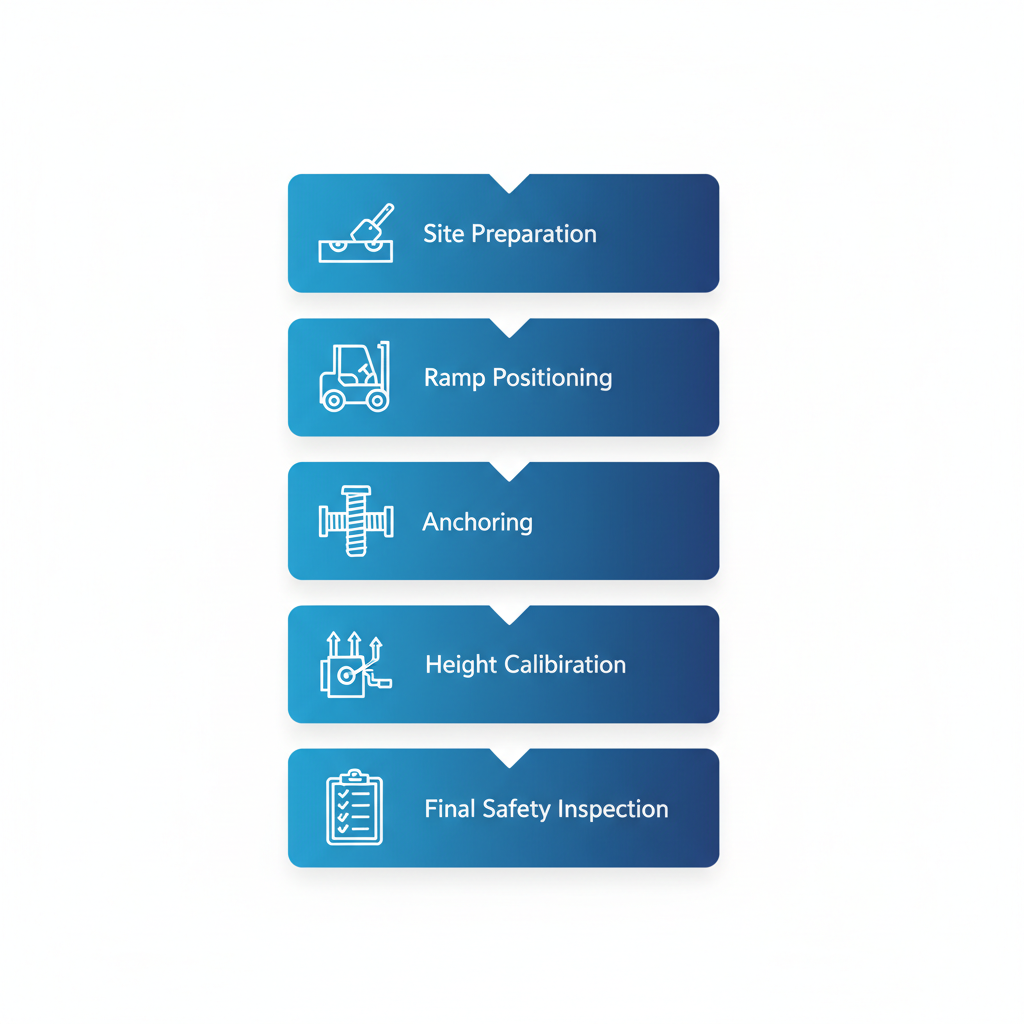
Step-by-step installation of forklift dock ramps for safe operations
By following these steps, facilities can minimize downtime and extend equipment life. Our rent-to-own programs offer flexible access to high-quality ramps, allowing businesses to implement these practices without significant upfront investment.
Portable vs. Stationary Options for Different Sites
Choosing between portable and stationary forklift dock ramps depends on operational flexibility, site constraints, and volume demands in environments like construction zones or high-traffic shipping yards. Portable models, often referred to as yard ramps, provide mobility for non-permanent setups, while stationary loading dock ramps offer enduring support for fixed docks. We guide clients in selecting based on factors such as relocation frequency, budget, and safety needs to optimize loading processes.
The following table compares key aspects of portable versus stationary forklift dock ramps:
| Option | Upfront Cost | Durability | Flexibility |
|---|---|---|---|
| New Purchase | High initial investment | Full warranty, premium materials: Permanent installation | Long-term ownership |
| Rental/Rent-to-Own | Low entry, scalable payments | Inspected used units: Short/long-term options | Easy upgrades |
Derived from industry standards, these comparisons highlight how costs are approximate and site-dependent, with maintenance aligned to OSHA recommendations. Portable yard ramps excel in scenarios requiring frequent repositioning, such as mobile loading inclines in recycling facilities, enabling quick adaptation without permanent alterations.
Stationary options, like fixed dock bridges, provide superior stability for daily warehouse loading, supporting heavier loads over time. In high-volume settings, they reduce long-term expenses through durability, though initial setup demands more investment. For construction or agribusiness sites, portable ramps facilitate ground-to-truck access where docks are absent, promoting efficiency. We offer both types through our nationwide facilities, including custom combos for specialized needs. Ultimately, portable ramps suit variable operations, while stationary ones fit consistent, high-throughput environments, ensuring safe and effective material flow.
For specialized needs, consider these advanced strategies.
Advanced Considerations for Industrial Use
For industrial operations in construction and shipping, where demands fluctuate and budgets require careful management, advanced options for forklift dock ramps provide essential flexibility. We offer rental programs, used equipment sales, and custom integrations through our multiple distribution centers across the United States, ensuring quick access and reliable support. These solutions help businesses scale efficiently while maintaining compliance and productivity.
Rental and rent-to-own programs are ideal for varying project needs, allowing access to a Forklift Dock Ramp without large upfront costs. Short-term rentals suit temporary construction sites, typically lasting weeks to months, while long-term options support ongoing shipping operations. Our rentable loading inclines undergo rigorous inspections to meet OSHA 1910.178 standards for powered industrial trucks, including approval labels and safe operation guidelines. For used yard ramps, we provide pre-owned dock bridges that have been certified for durability, with full documentation on load capacities and maintenance history. Rent-to-own preserves capital by converting payments toward ownership, subject to approval; contact our sales team for terms and conditions. We cover the entire USA with these options, drawing on 35 years in the material handling industry to deliver inspected units that integrate seamlessly with forklift extensions.
When evaluating acquisition paths, cost remains a key factor. New purchases demand significant investment but offer longevity, whereas rentals provide scalability.
Based on industry rental programs, always check certifications to ensure compliance. New purchases suit stable, high-volume facilities needing permanent solutions, while rentals fit dynamic environments like seasonal shipping, allowing upgrades as needs evolve. Medlin Ramps offers both for U.S. customers, emphasizing forklift ramps safety through OSHA-aligned practices.
Custom integrations elevate performance for specialized applications. We engineer loading dock ramps with extended lengths for larger loads or reinforced plating for heavy-duty use in manufacturing. These bespoke yard ramps incorporate accessories like guard rails, sourced durably in the US to withstand rigorous demands. Integration ensures smooth workflow, such as combining portable dock and ramp combos for ground-to-dock access. Do not exceed rated capacities; consult us for site-specific requirements. Our commitment to excellence serves one customer at a time, with customer service as king in every customization.
Common Questions About Forklift Dock Ramps
What are typical weight capacities for forklift dock ramps? Capacities range from 10,000 to 30,000 lbs, per OSHA 1910.178 standards. Select based on your forklift and load needs; do not exceed rated limits.
How do I choose the right size for my facility? Match ramp height to dock and truck levels, typically 36-60 inches adjustable. Ensure width accommodates forklift width for smooth access.
What safety features should forklift dock ramps include? Look for traction surfaces, side guards, and railings to prevent tipovers, as recommended by OSHA guidelines. Regular inspections maintain compliance.
Are rental or used yard ramps available? Yes, we offer rentals and used options with thorough inspections to ensure reliability. Rentals suit short-term needs, with rent-to-own programs available.
What is the maximum slope for a loading dock ramp? A 1:8 ratio is standard to avoid instability, per OSHA ramp guidance. Always follow manufacturer specifications for safe forklift navigation.
What are the benefits of steel construction in yard ramps? Steel provides superior durability and weather resistance for industrial ramp solutions, supporting heavy loads over time with minimal maintenance.
How do I maintain forklift dock ramps? Conduct daily visual checks and quarterly professional servicing. Lubricate moving parts and verify structural integrity to uphold safety standards.
Optimizing Loading Operations with Forklift Dock Ramps
In summary, a Forklift Dock Ramp provides essential capacities and safety features that streamline industrial loading operations. Our durable yard ramps and loading dock ramps, designed for longevity and compliance, offer flexible options like rentals to meet diverse needs across the United States. These efficient loading solutions align with MHI industry trends toward enhanced material handling practices.
We invite you to explore Medlin Ramps’ tailored solutions for your facility’s specific requirements. With our commitment to excellence serving the USA one customer at a time, we cover the entire USA through multiple distribution centers. Contact us today for a no-pressure consultation to optimize safety and efficiency in your loading processes. Results may vary based on site conditions; follow manufacturer guidelines for installation and use.
Resources
Explore Material Handling Industry Resources and Networking Opportunities
Learn Safe Forklift Load Handling Techniques with OSHA
Master Forklift Safety on Ramps and Grades per OSHA
Understand OSHA Standards for Powered Industrial Trucks Operations