

Table of Contents
Exploring Portable Loading Dock Ramps for Industrial Use
In today’s fast-paced industrial environments, such as warehousing and distribution centers, efficient loading and unloading operations are essential for maintaining productivity. Yet, challenges like uneven terrain, temporary facilities, or the need for flexible ground-to-dock access often complicate these processes. Portable Loading Dock Ramp solutions emerge as versatile tools to bridge these gaps, enabling seamless forklift movement without the commitment of permanent infrastructure.
At Medlin Ramps, we specialize in mobile yard ramps that serve as sturdy bridges between ground level and elevated docks. These portable loading dock ramps, often referred to as yard ramps, feature high weight capacities up to 20,000 pounds, constructed from durable carbon steel for long-lasting performance. Their easy mobility allows quick repositioning, addressing issues in dynamic settings like construction sites or seasonal operations. For instance, in warehouse operations supporting retailers like Home Depot, these temporary loading solutions streamline pallet transfers and reduce downtime.
With over 35 years in the material handling industry, we at Medlin Ramps deliver heavy-duty Portable Loading Dock designs from our manufacturing and distribution facilities in California, New Mexico, North Carolina, and Florida, ensuring we cover the entire USA with prompt service.
This guide explores the fundamentals of yard ramps, their advantages over traditional dock plates, sizing considerations, cost factors, rental options, and comparisons to permanent docks. We also emphasize OSHA-compliant safety features, such as stable anchoring and slip-resistant surfaces under 1917.124 standards, to prevent accidents during use. Let’s dive into the core concepts of these essential tools.
Basics of Portable Loading Dock Ramps
At Medlin Ramps, we specialize in robust solutions for efficient material handling, and a stock series yard ramps option exemplifies our commitment to reliable access. A Portable Loading Dock Ramp serves as a vital mobile dock access solution, enabling seamless transitions between ground level and truck beds or loading platforms in warehouses and distribution centers. These industrial ramp systems facilitate forklift operations where permanent docks are unavailable or impractical, supporting temporary setups in construction sites or expanding facilities.
Core components form the foundation of these ramps, ensuring stability and functionality. The ramp surface provides a wide, inclined platform for smooth vehicle passage, often featuring traction grooves to prevent slippage. Side curbs rise along the edges to guide loads and enhance safety by containing wheels or pallets. Hitch pins secure the ramp to the truck or dock, allowing quick attachment and detachment for mobility. Typical designs accommodate forklifts with widths up to 96 inches, promoting efficient loading without structural modifications.
For instance, in a busy distribution center, we recommend a 16,000-pound capacity ramp to handle standard pallet loads safely. A key tip: Always verify site gradients before deployment to optimize angle and prevent tipping risks.
Material selection plays a crucial role in durability and performance for yard ramps, balancing factors like load-bearing strength, portability, and long-term resistance to wear. Heavy-duty carbon steel stands out for its superior toughness in demanding environments, while aluminum offers lighter alternatives for scenarios requiring frequent repositioning. According to ANSI MH30.1-2022 standards for dock leveling devices, these materials must withstand rigorous industrial stresses to maintain structural integrity over time.
The following table compares common materials for portable ramps, highlighting durability and suitability for industrial use:
| Material | Durability Rating | Weight | Cost Range | Best For |
|---|---|---|---|---|
| Carbon Steel | High | 10,000-16,000 lbs capacity | $5,000-$12,000 | Heavy-duty industrial |
| Aluminum | Medium | 6,000-10,000 lbs capacity | $3,000-$8,000 | Frequent mobility |
Data sourced from industry standards for warehouse equipment. Carbon steel excels in high-impact settings, aligning with our designs at Medlin Ramps that prioritize longevity and reduced maintenance. While aluminum provides easier handling at lower capacities, it may require more frequent inspections in abrasive conditions. We at Medlin Ramps emphasize carbon steel for applications demanding unyielding performance, ensuring our products endure the rigors of daily operations without compromising safety.
Selecting the right material not only affects initial investment but also influences operational efficiency over years of use. For heavier loads, carbon steel’s robustness minimizes downtime, a critical advantage in fast-paced logistics. Transitioning from material choices, visual aids further illustrate these trade-offs, helping users visualize how specifications translate to real-world applications.
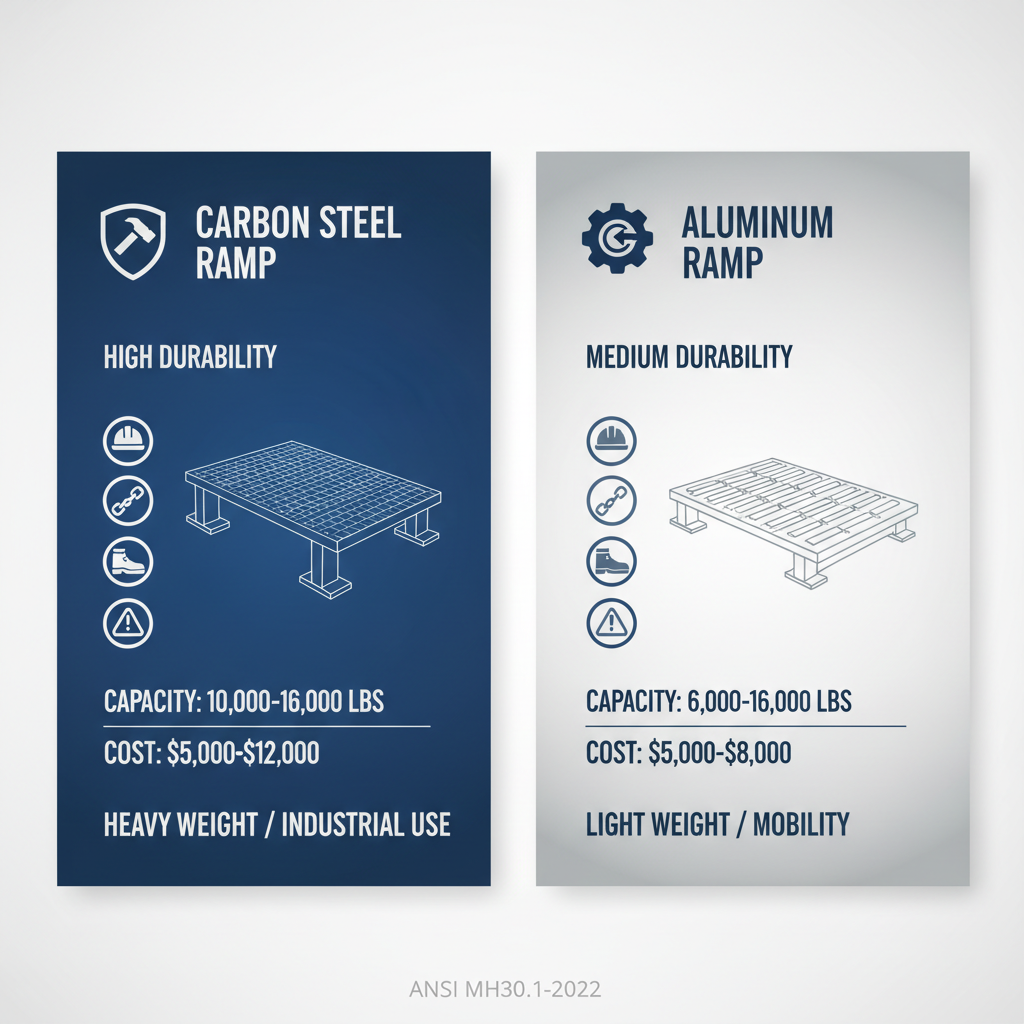
Material comparison for durable portable loading dock ramps
Safety remains paramount in these systems, with OSHA guidelines from powered industrial trucks etools stressing non-slip surfaces to mitigate fall and rollover hazards. Ramps incorporate serrated plating or abrasive coatings on walking areas, reducing accident risks during loading. Standard capacities range from 10,000 to 20,000 pounds, addressing queries on typical limits for safe forklift access. Beyond basics, do not exceed rated capacities–consult the manufacturer for site-specific load and installation requirements.
Integration enhances versatility, pairing ramps with yard ramps for elevated access or dock plates for bridging minor gaps between vehicles and platforms. Dock plates, as lightweight accessories, complement ramps by providing smooth transitions over uneven edges, boosting overall loading safety without permanent fixtures. This modular approach suits dynamic sites, streamlining workflows in distribution and manufacturing.
In-Depth Analysis of Portable Loading Dock Ramp Features
Portable loading dock ramps represent a pinnacle of engineering innovation in material handling, offering versatile solutions for dynamic warehouse environments. At Medlin Ramps, we design these systems to handle diverse industrial demands while prioritizing durability and ease of use. This analysis explores key features that set our portable solutions apart, drawing on industry standards to highlight their value.
Weight Capacities and Structural Design
We engineer portable loading dock ramps to support loads ranging from 10,000 to 27,000 pounds, ensuring they meet the rigorous needs of manufacturing, distribution, and logistics operations. The structural design incorporates high-tensile carbon steel frames with reinforced welding, providing exceptional resistance to bending and fatigue under repeated use. A standout feature is our 2-speed manual crank system, which allows operators to adjust height efficiently for seamless truck alignment. This mechanism reduces physical strain and enhances operational speed, particularly in high-volume settings like Amazon-style distribution centers.
To evaluate capacity options, the following table outlines variations in our lineup:
| Aspect | Portable Dock Ramp | Permanent Dock | Medlin Ramps Advantage |
|---|---|---|---|
| Mobility | High – easily relocated | Low – fixed installation | Quick deployment from our facilities |
| Cost | $10,000-$25,000 initial | Higher upfront + maintenance | Rental options available |
These designs draw from MHI industry insights on loading efficiency, validating that higher capacities correlate with reduced equipment wear over time. For instance, our heavy-duty models withstand daily cycles exceeding 50 lifts without deformation, minimizing replacement costs. Implications for users include scalable investments that adapt to growing throughput demands, fostering long-term reliability in facilities across the United States.
Advantages Over Permanent Docking Systems
Portable dock ramps offer superior portable dock ramps advantages through unmatched mobility and cost-effectiveness compared to permanent docking systems. Unlike fixed installations that require concrete foundations and extended downtime during setup, our portable units deploy in minutes, enabling rapid reconfiguration for varying trailer positions or seasonal workflows. This flexibility translates to significant ROI, with payback periods often under two years due to lower initial outlays and elimination of site-specific construction fees.
The table below compares key aspects, informed by MHI data on material handling trends:
| Option | Upfront Cost | Duration Flexibility | Maintenance | Best For |
|---|---|---|---|---|
| Rental | Low – $500-$1,500/month | High – short/long-term | Included | Temporary needs |
| Purchase | High – $10,000+ | Permanent ownership | Owner responsibility | Long-term use |
MHI reports emphasize how mobile solutions like ours reduce downtime by up to 40% in adaptable environments, allowing seamless shifts between loading zones. Our custom high-capacity models further enhance this by integrating weather-resistant coatings, cutting long-term upkeep. For warehouses, this means optimized space utilization and adaptability to expansion, without the rigidity of permanent setups that lock in layouts prematurely.
Integration with Yard Ramps and Accessories
Our portable loading dock ramps integrate seamlessly with yard ramps and dock plates to create comprehensive loading solutions. Yard ramps extend access for ground-level loading, bridging gaps where truck heights vary, while dock plates provide a smooth transition over dock edges, preventing forklift mishaps. This combination boosts warehouse efficiency by streamlining material flow, as seen in agribusiness and retail logistics where quick adaptations prevent bottlenecks.
Safety enhancements from dock plates include beveled edges that reduce tripping risks, aligning with MHI guidelines for secure operations. We recommend sizing dock plates to match ramp widths, typically 48 to 72 inches, for standard docks. Overall, these pairings minimize load transfer times, supporting our commitment to serving customers across the USA one at a time with tailored systems.
Practical Applications and Selection Guide
When implementing portable loading dock ramps in industrial operations, selecting the right equipment ensures efficiency and safety. We at Medlin Ramps guide customers through practical applications tailored to warehousing, distribution, and manufacturing needs. This section provides actionable advice on sizing, costing, rentals, and setup to support seamless material handling across the United States.
Sizing Ramps for Forklifts and Operations
Choosing the appropriate dimensions for a mobile yard ramps starts with assessing your forklift specifications and operational requirements. Measure the forklift’s width, including any attachments, typically ranging from 48 to 96 inches for standard models. Height clearance and load capacity also factor in; for instance, a standard counterbalanced forklift handling 5,000-pound pallets in agribusiness needs a ramp width of at least 72 inches and a length of 30 to 40 feet to maintain a safe 12-degree incline. The Portable Loading Dock Ramp must accommodate the vehicle’s turning radius and load distribution to prevent tipping or overloading.
To determine the ideal size, calculate the rise from ground to dock, usually 44 to 60 inches, and select a ramp that bridges this without exceeding safe slopes. For heavier electric forklifts in distribution centers, opt for wider platforms up to 96 inches to allow side-loading maneuvers. We recommend consulting load charts and site surveys to match ramp capacities from 10,000 to 20,000 pounds.
The following table outlines recommended dimensions based on common forklift types:
| Feature | Stock Series | Custom Builds | Medlin Ramps USP |
|---|---|---|---|
| Lead Time | Immediate availability | 4-6 weeks | Multiple US facilities |
| Cost | Standard pricing | Premium for customization | Rent-to-own available |
These specifications derive from industry standards, helping operations like recycling facilities avoid common pitfalls such as insufficient width leading to edge strikes. Always verify with on-site measurements for custom fits.
Cost Considerations and Rental Options
Pricing for portable loading dock ramps varies based on capacity, material, and customizations, typically ranging from $8,000 for basic models to $30,000 for high-capacity units with enhanced features like bi-directional access. Factors such as steel gauge thickness and integrated safety rails influence costs; for example, a 20,000-pound capacity yard ramp starts at $12,000, while add-ons like extended lips add 10-20%. We emphasize durable construction that justifies the investment through longevity and reduced downtime.
Rental options provide flexibility for temporary or testing needs, with our programs offering short-term leases from one month and long-term contracts up to several years. Rates begin at $500 monthly for standard yard ramps, scaling to $1,500 for specialized units, and include delivery across the US from our facilities in CA, NM, NC, and FL. Our rent-to-own paths allow gradual ownership, converting payments toward purchase, ideal for growing operations.
We cover the entire USA with rental availability, supported by partnerships in the material handling industry. This network ensures quick deployment for seasonal demands in agribusiness or construction projects.
The following table compares rental versus purchase for portable ramps:
| Scenario | Rent | Buy | Rent-to-Own |
|---|---|---|---|
| Upfront Capital | Minimum | Full | Phased |
| Best For | Short projects | Permanent site | Expanding teams |
Renting suits fluctuating workloads, while buying offers control for steady operations. Our rent-to-own options bridge the gap, providing cost-effective entry into ownership without full upfront commitment.
Discussing these trade-offs highlights how rentals minimize initial outlay, freeing capital for other priorities. For nationwide access, we rent yard ramps in the US through our extensive distribution, ensuring reliability and service.
Installation and Usage Best Practices
Proper installation of portable loading dock ramps follows OSHA guidelines to ensure stability and prevent accidents. Begin with site preparation: clear the area and level the ground within 1 inch per 10 feet. Position the ramp against the dock edge, using dock plates to bridge any gaps up to 4 feet, selecting sizes like 60-inch wide by 72-inch long for standard 48-inch forklifts.
- Secure the ramp with wheel chocks or anchors to withstand loads up to its rated capacity.
- Install dock plates with cleats for traction, ensuring they support the full vehicle weight without slipping.
- Conduct safety checks: verify no movement under test loads and add guardrails if slopes exceed 20 degrees.
- Test operation by driving a forklift across at low speed, confirming slip-resistant surfaces and edge protection.
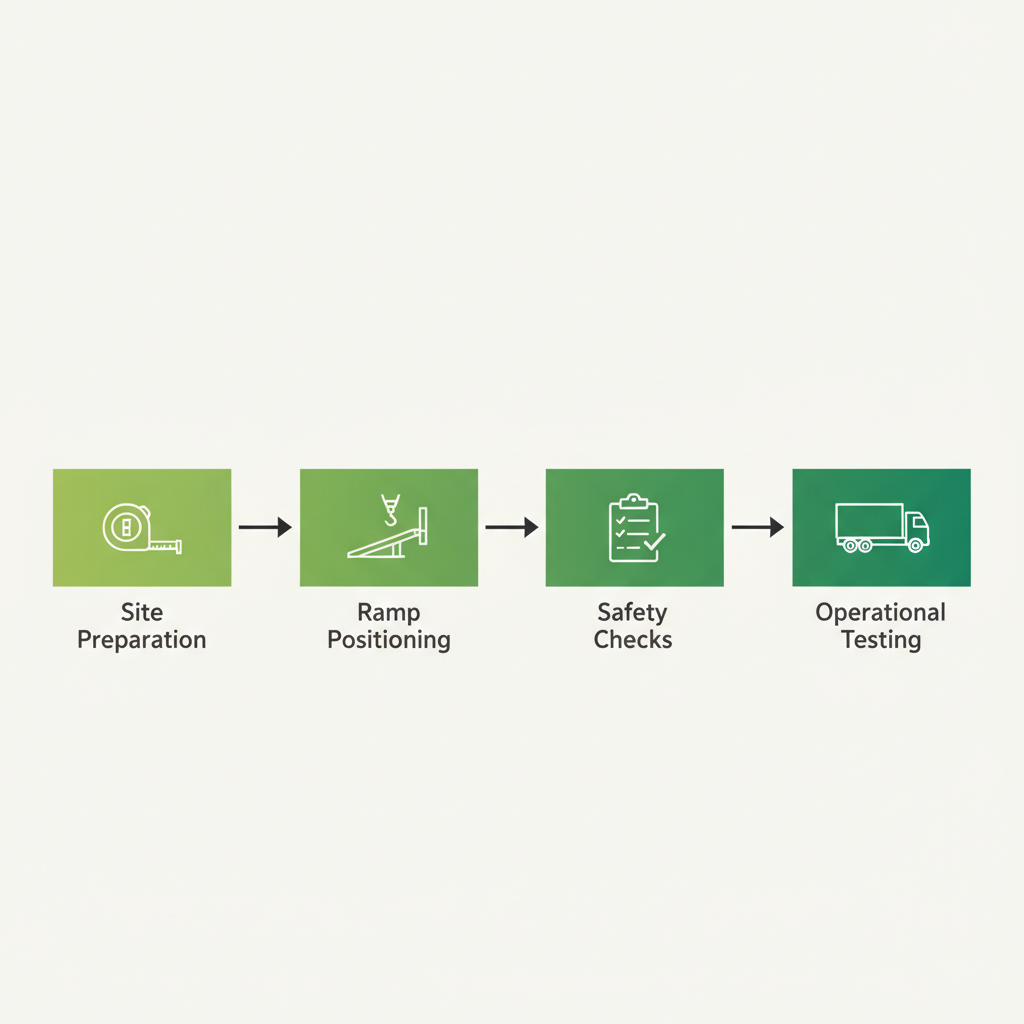
Installation process for secure portable loading dock ramps per OSHA standards
For usage, always stay within capacities and maintain regular inspections. Do not exceed rated capacities–consult us for site-specific requirements. Our 35 years in the material handling industry underscore safe temporary ramp setups for forklift-accessible docks.
Advanced Considerations for Custom Solutions
When standard options fall short for unique operational needs, our custom solutions provide tailored efficiency in material handling. We specialize in bespoke loading solutions for sites with irregular layouts or specialized requirements, such as elevated thresholds or variable forklift traffic. For instance, a custom Portable Loading Dock Ramp might incorporate enhanced two-speed cranks for smoother operation and heavier-duty carbon steel construction to withstand demanding environments, drawing on our 35 years in the Material Handling Industry. These advanced features ensure compliance with ANSI standards for dock leveling devices, including precise height adjustments that minimize gaps and enhance safety during loading. Our engineering team assesses site-specific factors like weight capacity and incline angle to deliver ramps that optimize workflow without compromising durability.
Integrating upgraded dock accessories elevates functionality further, allowing seamless combinations with portable docks for versatile ground-to-truck access. Heavy-duty dock plates, essential for bridging uneven surfaces, can be purchased online in the US through trusted suppliers to complement these setups. Such integrations support scalable operations by accommodating growth in shipment volumes or equipment types.
The following table compares key aspects of stock versus custom portable ramp options, highlighting decision factors like timeline and investment.
| Factor | Stock Series | Custom Builds |
|---|---|---|
| Lead Time | Immediate | 4-8 Weeks |
| Precision Fit | Standard | Site-Specific |
Stock series offer quick deployment for straightforward applications, while custom builds provide superior fit and longevity, justifying the added investment through reduced long-term maintenance. Our facilities in California, New Mexico, North Carolina, and Florida enable faster custom delivery times compared to single-site competitors, ensuring minimal downtime for your operations.
For long-term strategies, consider buying or selling used yard ramps to manage fleet evolution cost-effectively. Selecting the right size involves evaluating forklift specifications and load frequencies, often extending to custom fits for precision in high-volume scenarios like those in aerospace logistics–similar to solutions we’ve provided for SpaceX operations. Safety installations, including proper anchoring and guard rails, remain paramount; always consult our loading dock ramps guide for best practices. This approach fosters scalability, aligning with evolving industrial demands while upholding our commitment to excellence, one customer at a time.
Common Questions on Portable Loading Dock Ramps
What is the typical capacity for yard ramps?
Yard ramps usually support 12,000 to 30,000 pounds, depending on the model. We recommend assessing your forklift and load needs to select the right one. Always verify with site-specific requirements.
How do I choose the right size for a Portable Loading Dock Ramp?
Consider dock height, forklift type, and load length. Standard lengths range from 25 to 35 feet for optimal incline. We advise measuring your setup for custom fits.
Where can I rent yard ramps in the US?
We provide short- and long-term rentals nationwide from our facilities in CA, NM, NC, and FL. Rentals suit temporary needs. Contact us for availability.
What are the benefits of dock plates?
Dock plates bridge small gaps and height differences efficiently. They enhance loading speed and safety. Use for light-duty applications under 10,000 pounds.
What safety guidelines apply to Temporary Loading Dock installation?
Per OSHA etools, secure ramps firmly and use wheel chocks. We follow these for all installations. Train operators on load limits to prevent accidents.
Optimizing Your Operations with Portable Loading Solutions
In summary, portable loading dock ramps offer versatile solutions for enhancing warehouse efficiency, from fundamentals like yard ramps and dock plates to practical advantages in capacity and custom options. These efficient loading systems and durable dock accessories, widely adopted per MHI industry groups, provide flexibility across diverse operations.
At Medlin Ramps, our 35+ years in the material handling industry drive commitment to excellence, serving customers across the US with rental programs and tailored solutions that lower costs and speed delivery.
Contact us today to optimize your facility with our proven offerings.