

Table of Contents
Portable Yard Ramps Fundamentals
In today’s fast-paced logistics, inefficient ground-to-dock transitions can slow operations and raise costs. A Portable Yard Ramp offers a versatile solution, especially for those searching for a portable yard ramp for sale. These mobile loading ramps bridge the gap between ground-level trucks and dock heights, enabling smooth forklift access without permanent infrastructure.
At Medlin Ramps, with 35 years in the Material Handling Industry, we provide durable portable yard ramps crafted from heavy-duty carbon steel. Featuring 2-speed manual cranks for easy height adjustment, they support capacities from 10,000 to 30,000 lbs, aligning with Material Handling Industry standards for safety and efficiency. For instance, in a distribution center like an Amazon fulfillment warehouse, these ramps facilitate quick loading of pallets onto flatbed trailers or rail cars where docks are absent. Initial costs start around $10,000 for standard models, with options for new, used, and rental units to fit various budgets.
We also offer mobile yard ramps for enhanced maneuverability in tight spaces and dock to ground ramps for fixed-site needs, serving as essential ground-to-dock access equipment. Our nationwide distribution from facilities in California, New Mexico, North Carolina, and Florida ensures faster delivery across the United States. As MHI industry groups highlight, adoption of such equipment boosts logistics applicability in manufacturing and retail, with proven efficiency in commercial settings.
Exploring capacities and features next helps buyers select the right fit, considering site-specific factors like load requirements and terrain.
Understanding Portable Yard Ramps
Portable yard ramps serve as essential tools in warehouse operations, enabling safe and efficient loading and unloading of trucks without permanent dock installations. At Medlin Ramps, we specialize in these versatile solutions, drawing on our 35 years in the Material Handling Industry to deliver products that enhance productivity. This section explores their key features, capacity options, and types to help you select the right ramp for your needs.
Key Features and Specifications
Portable yard ramps are engineered for rugged industrial use, featuring heavy-duty carbon steel frames that provide exceptional durability. We use welded construction to withstand demanding environments, with anti-slip serrated steel grating surfaces ensuring safe forklift traction even in wet conditions. Adjustment mechanisms include our reliable 2-speed crank system, allowing precise height alignment from 36 to 54 inches to match various truck beds.
Standard dimensions typically range from 30 to 46 feet in length and 60 to 96 inches in width, accommodating different warehouse layouts. Safety features such as 8-inch run-off curbs and safety chains prevent accidents, aligning with Material Handling Industry (MHI) guidelines for load testing and material strength. For those seeking a Portable Yard Ramp Price that fits their budget, we offer options including used portable yard ramps through our buy/sell programs, as well as rentals for short-term needs.
In a 20,000 square foot distribution center, these relocatable loading platforms streamline operations by bridging ground to truck levels efficiently.
Capacity and Size Options
Selecting the appropriate capacity and size for a portable yard ramp depends on your warehouse traffic and equipment. Capacities range from 10,000 lbs for lighter duties to 30,000 lbs for heavy industrial applications, with common tiers at 16,000, 20,000, 27,000, and 30,000 lbs. These ratings, validated by MHI safety standards, ensure compatibility with standard forklifts up to 10,000 lbs, preventing overload risks.
Lengths of 30-46 feet and widths from 60-96 inches allow customization based on door heights of 48-60 inches and truck types like flatbeds or trailers. We recommend starting with your peak load requirements: for moderate traffic, a 20,000 lb capacity 36-foot ramp suffices, while high-volume sites benefit from 30,000 lb models. Consider a selection flowchart–assess forklift weight, then match length to approach angle for optimal safety and flow.
This approach addresses common queries on available capacities, ensuring your choice supports seamless operations without exceeding rated limits.
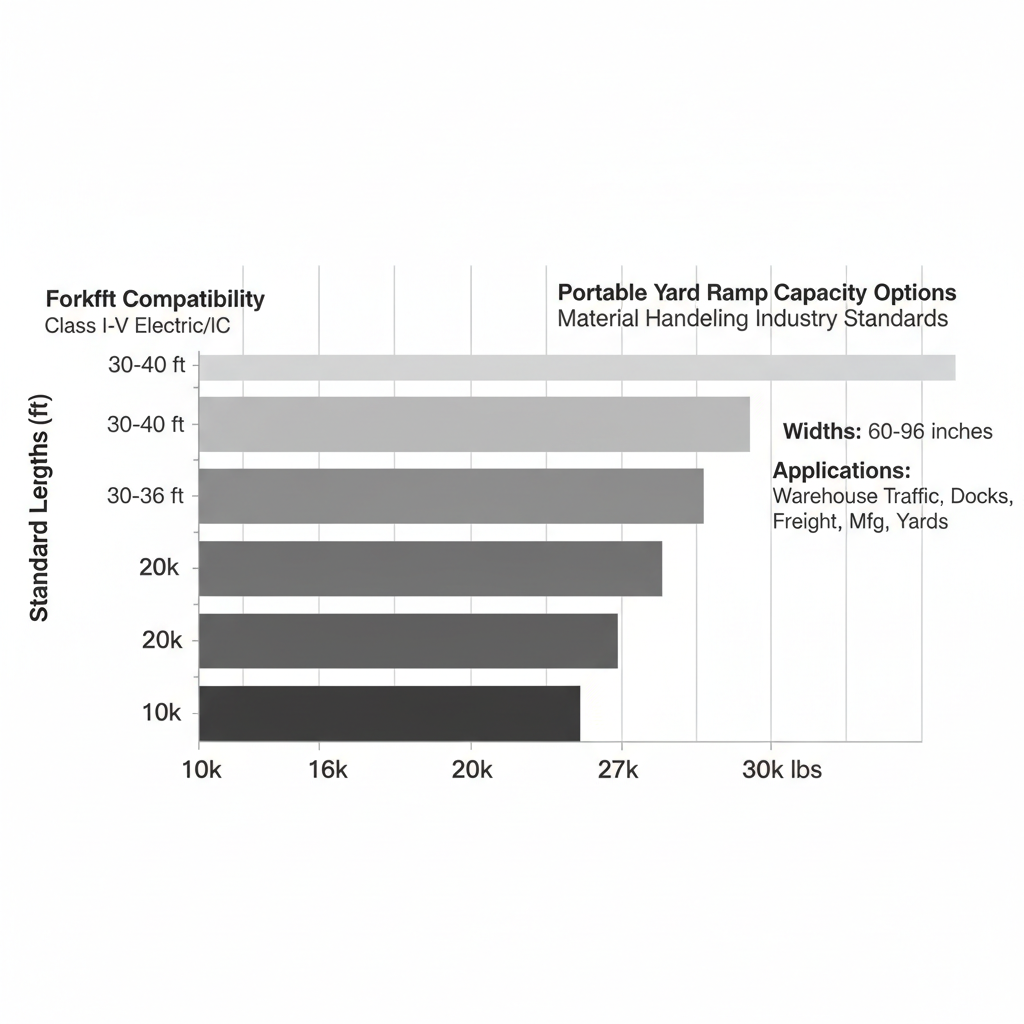
Portable yard ramp capacity options and specifications overview
Reviewing these visual breakdowns reinforces how capacities align with dimensions, guiding informed decisions for your facility’s scale.
Types Including Mobile and Dock to Ground Variants
Portable yard ramps come in variants tailored to flexibility and stability needs. Mobile yard ramps excel in maneuverability, featuring tow bars or clamps for easy relocation across yards, ideal for dynamic sites like construction or temporary setups.
In contrast, dock to ground ramps provide semi-permanent ground-level dock bridges, bolted for enhanced stability in fixed distribution centers.
Pros of mobile yard ramps include quick repositioning and no installation downtime, though they require more storage space. Dock to ground ramps offer superior load transfer with minimal vibration but demand site preparation.
We recommend mobile options for versatile operations and dock to ground for high-frequency use, both backed by our rent-to-own programs. This comparison helps differentiate types, supporting choices like used models from our inventory for cost savings.
Benefits of Portable Yard Ramps
At Medlin Ramps, we have seen firsthand how portable yard ramps transform warehouse operations for our clients across the United States. With over 35 years in the Material Handling Industry, our commitment to excellence serves one customer at a time by providing versatile loading solutions that enhance productivity and safety. These ramps offer superior flexibility compared to fixed docks, allowing seamless adaptive dock access in dynamic environments like distribution centers and manufacturing plants.
Enhanced Efficiency in Warehouse Operations
Portable yard ramps streamline loading and unloading processes, significantly reducing downtime in commercial logistics. By enabling direct ground-to-truck access without relying on fixed infrastructure, they facilitate faster pallet transfers. Industry data from the Material Handling Industry (MHI) indicates that such equipment can reduce labor requirements by up to 30% through quicker truck turnaround times, minimizing idle periods for forklifts and personnel.
In a typical warehouse scenario, mobile yard ramps allow operators to position the ramp precisely at varying truck heights, adapting to seasonal overflow or irregular deliveries. This flexibility improves overall throughput, as seen in a recycling facility we equipped, where loading times dropped from 45 minutes to under 20 per truck. Our clients report enhanced workflow efficiency, with portable ramps integrating seamlessly into high-volume operations. For instance, they support heavy equipment movement without the constraints of permanent docks, ensuring continuous material flow.
Key benefits include:
- Reduced forklift travel distance, cutting fuel and time costs.
- Versatile positioning for multiple loading bays.
- Compatibility with diverse truck sizes, boosting adaptability.
These advantages make portable yard ramps essential for scaling operations efficiently.
Cost Savings and Flexibility Options
One of the primary appeals of portable yard ramps lies in their financial advantages, offering options like rentals and used purchases that deliver strong long-term ROI. Rentals typically range from $500 to $1,500 per month, providing immediate access without the upfront capital outlay of buying new units, which start at over $10,000. For those considering a portable yard ramp for sale, used models are available at 40-60% off new prices, allowing businesses to test applications before committing.
To illustrate ROI, consider a mid-sized distribution center investing in a used ramp at $6,000. With potential labor savings of 20 hours weekly at $25 per hour, payback could occur within 12 months–though results are site- and application-dependent. Mobile yard ramps excel in dynamic layouts, such as seasonal demands, while dock to ground ramps suit high-volume, permanent sites for stable access.
This flexibility reduces long-term expenses by avoiding costly retrofits. Financing and rental terms are subject to approval; contact our sales team for details.
Safety and Durability Advantages
Safety remains paramount in high-traffic industrial settings, and portable yard ramps from a trusted yard ramps manufacturer like Medlin Ramps incorporate robust features to minimize risks. Constructed from heavy-duty carbon steel, these ramps withstand demanding use, with non-slip decks preventing slips during heavy equipment loading. MHI standards underscore how such designs can lower accident rates by improving stable transitions from ground to truck beds.
Durability ensures longevity with minimal maintenance; our 2-speed manual crank systems allow easy height adjustments, reducing wear on components. In a manufacturing plant case, a client using our ramps reported zero loading-related incidents over two years, thanks to integrated safety chains and edge guards that secure connections.
Essential safety features include:
- Anti-skid surfaces for all-weather reliability.
- Reinforced side rails to contain forklifts.
- Capacity ratings up to 20,000 lbs–do not exceed rated capacities; consult the manufacturer for site-specific requirements.
Follow manufacturer instructions and use qualified technicians for installation, maintenance, and repairs; safety procedures must always be observed. These elements not only protect workers but also extend equipment life, providing reliable performance in warehouses, recycling facilities, and beyond.
How Portable Yard Ramps Work
Portable yard ramps provide versatile solutions for efficient loading and unloading in industrial environments, bridging the gap between ground level and truck beds or docks. These medlin ramps supplier offerings, including mobile and stationary models, enhance workflow in warehousing and distribution. We emphasize safe practices aligned with Material Handling Industry (MHI) standards to ensure reliability and compliance. This section outlines the operational essentials, from initial setup to ongoing maintenance, helping facilities optimize their material handling processes.
Installation and Setup Process
Setting up portable yard ramps requires careful planning to match your site’s needs, whether for temporary or long-term use. For those considering a portable yard ramp for sale, evaluate if a permanent installation suits ongoing operations or if mobility better fits variable demands.
- Position the ramp: Locate the ramp near the loading area on level ground, ideally in a construction site or warehouse yard. Use wheel chocks to prevent slippage, positioning the ramp’s approach end toward the forklift path.
- Secure the structure: Attach safety chains to anchor points on the dock or truck, following MHI guidelines for stability. This contrasts with dock to ground ramps, which often involve bolted installations for fixed access.
- Adjust the height: Employ the two-speed manual crank to raise or lower the ramp, aligning the top plate with the dock edge at 40 to 60 inches. We advise verifying the angle does not exceed recommended slopes for safe traversal.
- Verify alignment: Check that the adjustable loading bridges connect smoothly, ensuring forklift access platforms remain flush.
- Test stability: Conduct a load test with minimal weight before full operation, consulting manufacturer instructions.
These steps, informed by MHI operational standards, typically take 30-45 minutes and promote secure setups. Do not exceed rated capacities–consult the manufacturer for site-specific load and installation requirements.
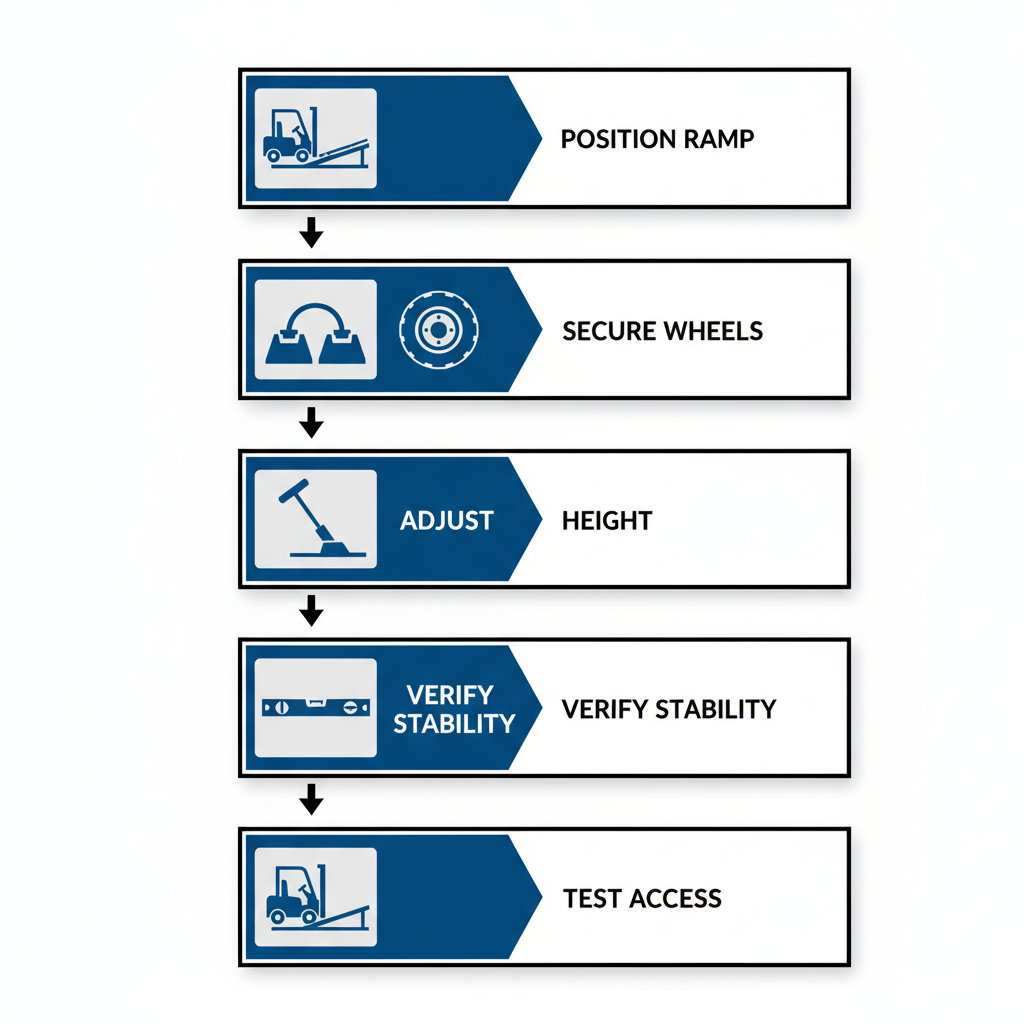
Step-by-step installation guide for portable yard ramps
Following this visual guide reinforces best practices, allowing teams to integrate ramps seamlessly into daily routines.
Daily Operation and Forklift Integration
Once installed, operating portable yard ramps involves coordinated protocols to maximize efficiency while prioritizing safety. Mobile yard ramps excel in flexibility, enabling towing between bays for repositioning as needs change.
We recommend these MHI-aligned safety checklists for forklift integration:
- Maintain speeds under 5 mph on the ramp surface to avoid vibrations.
- Use hand signals or radios for clear communication between operators and spotters.
- Ensure loads do not overhang, especially for heavy equipment up to rated capacities like 30,000 pounds.
During loading, drive forklifts straight up the ramp, centering the load for balance. For dock to ground ramps, integration focuses on fixed transitions, but portable models allow quick adjustments via cranks. In high-traffic areas, designate one-way paths to manage flow and reduce collision risks.
Our 35 years in the Material Handling Industry highlight how these protocols, including routine signaling, prevent incidents and support smooth logistics. Results and productivity improvements are site- and application-dependent; outcomes may vary.
To transition effectively, operators should pause at the top to confirm secure footing before proceeding to the dock.
Maintenance and Rental Logistics
Routine maintenance sustains the longevity of portable yard ramps, with MHI recommending inspections at least quarterly. Focus on greasing pivot points and checking welds for wear, particularly after heavy use.
Establish a schedule:
- Daily checks: Inspect chains, chocks, and surface for debris.
- Weekly lubrication: Apply grease to cranks and hinges to ensure smooth height adjustments.
- Annual professional review: Engage certified technicians for structural evaluations, addressing any corrosion or fatigue.
For rentals, we cover the entire USA through our multiple distribution centers in California, New Mexico, North Carolina, and Florida, offering delivery within days. Short-term leases suit seasonal peaks, while rent-to-own programs allow gradual ownership transitions. Handling used units involves verifying serial numbers and capacities before redeployment.
Follow manufacturer instructions and qualified technicians for maintenance and repairs; safety procedures must be observed. Financing and rental terms are subject to approval; contact sales for terms and conditions.
This approach ensures ongoing reliability, aligning with our commitment to excellence in serving customers one at a time.
Best Practices for Portable Yard Ramps
Based on our 35 years in the Material Handling Industry, we recommend following these best practices to maximize the efficiency and safety of portable yard ramps in your operations. These durable access solutions enhance loading and unloading processes, particularly in dynamic warehouse environments like agribusiness facilities handling bulk shipments.
Selecting the Right Size and Capacity
Assessing your warehouse needs is crucial for choosing the optimal portable yard ramp. Start by measuring dock bay dimensions and trailer heights; for standard 53-foot trailers, a 36-foot length provides adequate incline and level-off for smooth transitions. Consider traffic volume and forklift specifications–select capacities from 10,000 to 20,000 pounds to match maximum loads, ensuring safety margins as per MHI guidelines on material handling equipment.
Use this checklist to guide your selection:
- Evaluate daily throughput: High-volume sites need wider decks, up to 96 inches.
- Factor in ground conditions: Uneven surfaces require adjustable heights from 34 to 60 inches.
- Consult forklift ratings: Ramp capacity should exceed combined vehicle and load weight by 20%.
These customizable loading aids prevent bottlenecks and reduce injury risks. In our experience serving distribution centers, proper sizing cuts loading times by up to 30%, though results vary by site.
Implementation in Warehouse Workflows
Integrating mobile yard ramps into daily operations requires strategic planning for seamless adaptability. Position ramps in designated zones away from main aisles to minimize congestion, using towable models for quick relocation between docks. For dock to ground access, stationary variants offer reliable endurance in fixed workflows, such as receiving areas.
Train staff on safe usage: Emphasize load centering to avoid tipping and secure ramps with safety chains during operation. In agribusiness, for instance, we have seen mobile yard ramps streamline pallet transfers for hay and feed, integrating with zoning to separate inbound and outbound traffic.
Visualize workflows with these steps:
- Map high-traffic zones for ramp placement.
- Schedule regular inspections for hydraulic functions and grating integrity.
- Incorporate into shift rotations for efficient dock utilization.
This approach optimizes throughput while adhering to OSHA standards, fostering a safer environment.
Sourcing Used, New, or Rental Options
When sourcing, evaluate options based on project duration and budget; certified sellers like us provide reliable new, used, and rental portable yard ramps. For short-term needs, rentals offer flexibility without large upfront costs, ideal for seasonal agribusiness surges. Long-term investments favor purchases of new units for durability, while used ramps from verified auctions, such as municipal sales in Fort Lauderdale, suit cost-conscious buyers–always inspect for structural integrity.
Consider a portable yard ramp for sale if expanding permanently, but compare via this decision matrix:
| Option | Upfront Cost | Best For | Flexibility |
|---|---|---|---|
| New | Highest | Long-term reliability | Low |
| Used | Medium | Cost-conscious buyers | Moderate |
| Rental | Lowest | Seasonal surges | Highest |
Costs for dock to ground ramps in fixed setups range $10,000-$20,000, depending on capacity; factor maintenance and delivery. We cover the entire USA, including yard ramps texas, with rent-to-own programs. Do not exceed rated capacities–consult us for site-specific requirements. Procurement best practices from MHI emphasize warranties and compliance checks to ensure value.
Optimizing Warehouse Efficiency with Yard Ramps
In summary, portable yard ramps offer versatile solutions for streamlining warehouse operations, with options like mobile yard ramps and dock to ground ramps providing flexible access for loading and unloading. Capacities range from 10,000 to 30,000 pounds, accommodating various forklift and pallet needs, while costs typically fall between $8,000 and $25,000 depending on size and features tailored to specific operations, such as retail logistics setups handling high-volume shipments. Availability includes new purchases, used equipment through channels like city auctions in Fort Lauderdale, and rental programs for short-term projects. Regular maintenance ensures longevity and safety, reinforcing these efficient loading systems as reliable dock solutions.
At Medlin Ramps, our 35 years in the Material Handling Industry equip us to deliver nationwide support, including specialized options for regions like yard ramps kentucky. We emphasize durability and personalized service to enhance safety and productivity without overpromising results, which vary by site. We invite you to contact us for quotes on a portable yard ramp for sale or rental arrangements suited to your needs. Our commitment to excellence serves customers across the USA, one at a time, helping optimize your workflow effectively.