

Table of Contents
Understanding Ground Level Dock Ramps
In modern warehousing and distribution, facilities without traditional loading docks face unique challenges in efficient material handling. A ground level dock ramp serves as a vital solution, providing a sturdy bridge from ground level to elevated dock heights for seamless loading and unloading. We at Medlin Ramps, with over 35 years in the material handling industry, specialize in these essential tools to enhance operations across the United States.
Ground level dock ramps, often constructed from heavy-duty carbon steel, come in portable or stationary designs tailored for manufacturing and logistics applications. For instance, a dock to ground ramp facilitates safe descent for forklifts transporting goods from the dock to the yard, while a ground to dock ramp enables easy ascent for incoming loads. These loading dock bridges improve forklift access, reduce physical strain on workers, and minimize injury risks, aligning with OSHA regulations under 29 CFR 1917.124 that mandate secure dock access to prevent falls and equipment mishaps. By promoting compliance and efficiency, they boost productivity in environments like Amazon’s vast logistics networks.
At Medlin Ramps, our portable dock access ramps address these needs through innovative No Dock Loading Solution options, ensuring durability and high-capacity performance. Manufacturing from our facilities in California, New Mexico, North Carolina, and Florida allows us to deliver nationwide with faster response times. This section explores the fundamentals of these ramps, their functionality, and key selection criteria to help you optimize your facility’s safety and workflow. Remember, results and productivity improvements are site- and application-dependent; always consult manufacturer guidelines and do not exceed rated capacities.
Fundamentals of Ground Level Dock Ramps
At Medlin Ramps, we specialize in engineered solutions for material handling challenges across various industries. A ground level dock ramp provides essential access between elevated docks and ground level, ensuring safe and efficient loading and unloading operations. These devices address common warehouse obstacles by bridging height differences, reducing manual handling risks, and supporting heavy equipment like forklifts.
A dock to ground ramp acts as a dock access bridge, facilitating the descent of loads from the dock to ground level for unloading. This type is particularly useful in scenarios where goods need to be lowered efficiently, such as in distribution centers where pallets arrive at dock height but require ground-level storage or transport. In contrast, a ground to dock ramp functions as a level loading platform, enabling the ascent from ground to dock for loading purposes. It supports operations in manufacturing and shipping environments, where materials start at floor level and must reach elevated docks for processing or dispatch. Typical weight capacities for these ramps range from 10,000 to 20,000 pounds, depending on design and application. We recommend consulting manufacturers for site-specific requirements, as exceeding rated capacities can compromise safety. Do not exceed rated capacities–consult the manufacturer for site-specific load and installation requirements.
The core components of a ground level dock ramp are designed for durability and functionality. We fabricate our ramps using high-quality carbon steel to withstand rigorous industrial use, ensuring longevity in demanding environments like standard warehouse setups.
- Ramp surface: A wide, non-slip platform that accommodates forklifts and pallet jacks, typically featuring serrated edges for traction.
- Legs: Adjustable support legs that stabilize the ramp on flat or sloped surfaces, allowing for precise leveling during installation.
- Safety rails: Protective barriers along the sides to prevent falls, often including curbs and chain barriers for added security during operations.
Our stock series offers standard configurations ideal for common needs, providing reliable performance without custom modifications. These elements work together to create a seamless transition for material flow, minimizing downtime and enhancing productivity in everyday logistics tasks.
Compliance with industry standards is paramount for safe ramp usage. Ground level dock ramps must adhere to OSHA regulations, which mandate secure footing and load-bearing integrity to protect workers from hazards. Additionally, ANSI MH30.1 standards guide the design of dock leveling devices, emphasizing proper component integration for stability. According to ANSI guidelines on leveling devices, ramps should incorporate features like anti-skid surfaces and reinforced structures to handle dynamic loads effectively. We design our ramps to meet these ANSI standards, drawing from 35 years in the material handling industry to deliver compliant solutions that prioritize worker safety and operational efficiency.
Ground level dock ramps primarily come in two variants to suit different access needs: the dock to ground ramp for unloading and the ground to dock ramp for loading. The dock to ground ramp facilitates descent from dock to ground, offering high portability for flexible setups in warehousing and distribution. Meanwhile, the ground to dock ramp enables ascent from ground to dock, with medium to high portability suited to manufacturing and shipping demands.
The following table compares these types based on key attributes, with data sourced from ANSI MH30 standards for dock devices:
| Type | Primary Use | Portability | Typical Height Range |
|---|---|---|---|
| Dock to Ground Ramp | Facilitates descent from dock to ground for unloading | High | 24-48 inches |
| Ground to Dock Ramp | Enables ascent from ground to dock for loading | Medium to High | 36-60 inches |
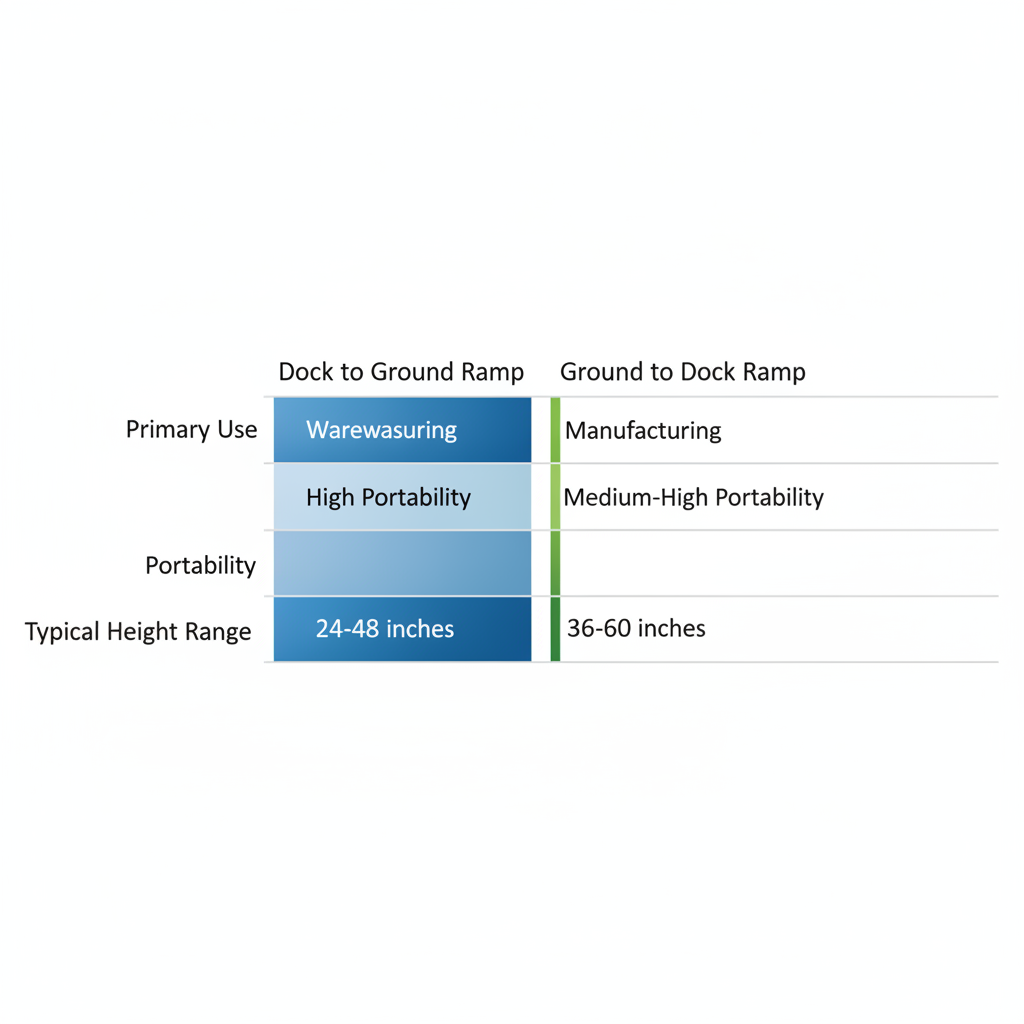
Comparison of ground level dock ramp types and attributes
This comparison underscores the differences in design and application, helping facilities choose based on specific requirements like space constraints or load frequency. For instance, high-portability options excel in temporary operations, while medium-portability models support more permanent installations. Height ranges reflect standard facility docks, ensuring compatibility with common setups.
Selecting the right type depends on your operational needs, such as the direction of material flow and site terrain. Facilities with frequent unloading may prioritize dock to ground ramps for quick ground access, whereas loading-heavy environments benefit from ground to dock variants. We offer versatile options, including our Ground Level Loading Dock configurations, to match diverse applications while maintaining ANSI compliance. Understanding these fundamentals allows for informed decisions that enhance safety and efficiency.
Building on these basics, exploring advanced features like customization and installation best practices can further optimize ramp performance in real-world scenarios.
In-Depth Analysis of Dock Ramp Functionality
At Medlin Ramps, we understand that ground level dock ramps are essential for streamlining material handling in industrial environments. These versatile structures bridge the gap between ground level and loading docks, enabling seamless transitions for forklifts and other equipment. Our designs facilitate efficient operations in warehouses and distribution centers, reducing manual labor and enhancing overall productivity.
How Ground Level Dock Ramps Enhance Loading Processes
Ground level dock ramps transform warehouse loading by providing a stable platform for forklift operations. During unloading, a dock to ground ramp allows vehicles to descend safely from the dock to the yard, minimizing the risk of tipping and enabling direct pallet transfer to ground storage. Forklifts navigate the incline with ease, thanks to the ramp’s gradual slope, which typically ranges from 10 to 16 degrees depending on the model.
In loading scenarios, the ground to dock ramp supports ascent, allowing operators to elevate loads directly onto trucks without intermediate staging. This integration cuts workflow time by up to 30 percent, according to MHI industry benchmarks on material handling efficiency. For instance, in a high-volume facility like those serving Home Depot, these ramps enable continuous flow, reducing downtime and bottlenecks during peak shifts.
We incorporate features like anti-slip surfaces to ensure secure traction, further optimizing the process. The following table compares fixed and portable variants in terms of key operational aspects:
| Aspect | Stationary Ramp | Portable Ramp |
|---|---|---|
| Installation Time | Permanent, 1-2 days | Quick setup, under 1 hour |
| Mobility | Fixed location | Relocatable across sites |
Based on MHI benchmarks, stationary ramps offer reliability for fixed workflows, while portable options provide adaptability for varying site needs. However, portable models may require occasional repositioning, which our team handles efficiently to maintain operational flow.
This comparison highlights how choosing the right type can align with specific loading demands, ensuring smoother transitions and less disruption in daily routines.
Safety and Capacity Considerations in Operation
Safety remains paramount when operating ground level dock ramps, with our products engineered to meet rigorous standards. Weight ratings commonly reach up to 20,000 lbs, supported by robust structural integrity from high-tensile steel construction. Safety rails and secure footing prevent falls, aligning with OSHA 1917.124 regulations that mandate clear access and non-slip surfaces during loading activities.
Regulatory compliance is embedded in our designs, including yellow safety stripes and chain barriers to alert operators. In practice, these features safeguard workers in dynamic environments, such as manufacturing facilities across the US, where the warehouse loading bridge serves as a critical industrial dock connector. MHI resources emphasize that proper capacity adherence can reduce incidents by 25 percent in material handling operations.
For example, our clients in distribution centers report fewer near-misses after implementing these ramps with integrated guardrails. To further illustrate capacity variations, consider the table below comparing types:
| Facility Type | Recommended Length | Capacity Range |
|---|---|---|
| Small Warehouse | 30-40 ft | 10,000-15,000 lbs |
| Large Distribution Center | 40-60 ft | 15,000-25,000 lbs |
These differences ensure that stationary models handle heavier, consistent loads, while portables suit variable applications. Always verify site-specific requirements to maintain compliance and longevity.
The emphasis on these elements underscores our commitment to excellence, serving one customer at a time with reliable solutions.
Portability and Installation Variations
Portability defines the flexibility of ground level dock ramps, allowing adaptation to changing facility layouts. Portable models, such as our stock series yard ramps, feature hitch points for easy towing by forklift or vehicle, enabling relocation within minutes.
Stationary installations involve bolting to concrete foundations, ideal for permanent dock access in fixed warehouses. This setup enhances stability for high-frequency use but limits mobility. In contrast, portable variants support outdoor applications with weather-resistant coatings, suitable for construction sites or temporary setups.
Our 35 years in the material handling industry inform these options, providing clients like Amazon with tailored flexibility. Installation variations impact overall efficiency, as portable ramps reduce setup costs and downtime compared to permanent embeds. We cover the entire USA through our multiple distribution centers, ensuring quick delivery and support for any configuration.
Practical Implementation of Dock Ramps
Implementing ground level dock ramps effectively requires careful planning to enhance loading operations in warehousing and distribution centers. We focus on practical steps that align with industry standards, ensuring safety and efficiency for our customers across the United States. By selecting the appropriate specifications and following best practices, facilities can optimize material handling processes without unnecessary downtime.
Selecting the Right Size and Capacity
Choosing the right ground level dock ramp begins with assessing your facility’s specific needs, including door height, truck bed dimensions, and expected load volumes. We recommend measuring the rise required for access, typically aiming for a 1:12 rise-to-run ratio to minimize forklift incline angles and reduce operator fatigue. For instance, if your dock height is 48 inches, a ramp length of at least 36 feet provides a safe slope under 4 degrees, promoting smoother transitions during loading.
Capacities should match your heaviest forklifts or pallet jacks, often ranging from 10,000 to 25,000 pounds depending on the operation scale. Consider rental options for ground to dock ramps to test fit before committing to a purchase; this allows evaluation of performance in real conditions without upfront investment. Always consult ANSI MH30.2 standards for leveling and load distribution to avoid structural issues.
The following table outlines size recommendations based on facility type and load requirements, derived from ANSI guidelines and forklift capacity standards:
| Feature | Standard Model | Custom Model |
|---|---|---|
| Lead Time | Immediate stock | 4-6 weeks |
| Adaptability | Basic fits | Tailored to site |
This comparison highlights how smaller setups benefit from compact designs, while larger operations demand extended lengths for heavier throughput. We advise pairing these specs with custom adjustments for unique layouts, ensuring the ramp integrates seamlessly with existing infrastructure. Rental programs can further help determine the ideal capacity, addressing questions on cost and availability for dock to ground ramps in the US.
Installation and Maintenance Best Practices
Proper installation of dock to ground ramps safeguards against accidents and extends equipment life. We outline a step-by-step process grounded in ANSI MH30.2 for dock leveling devices, emphasizing secure anchoring to concrete pads.
- Conduct site assessment: Evaluate soil stability and dock alignment to confirm the location suits a facility loading ramp.
- Position the ramp: Align it precisely with the dock edge, using temporary supports for initial placement.
- Level and anchor: Adjust hydraulic legs or shims for even distribution, then bolt securely to the foundation.
- Perform safety checks: Install guardrails and edge markers to prevent falls.
- Load test: Gradually apply weights up to rated capacity with a forklift to verify stability.
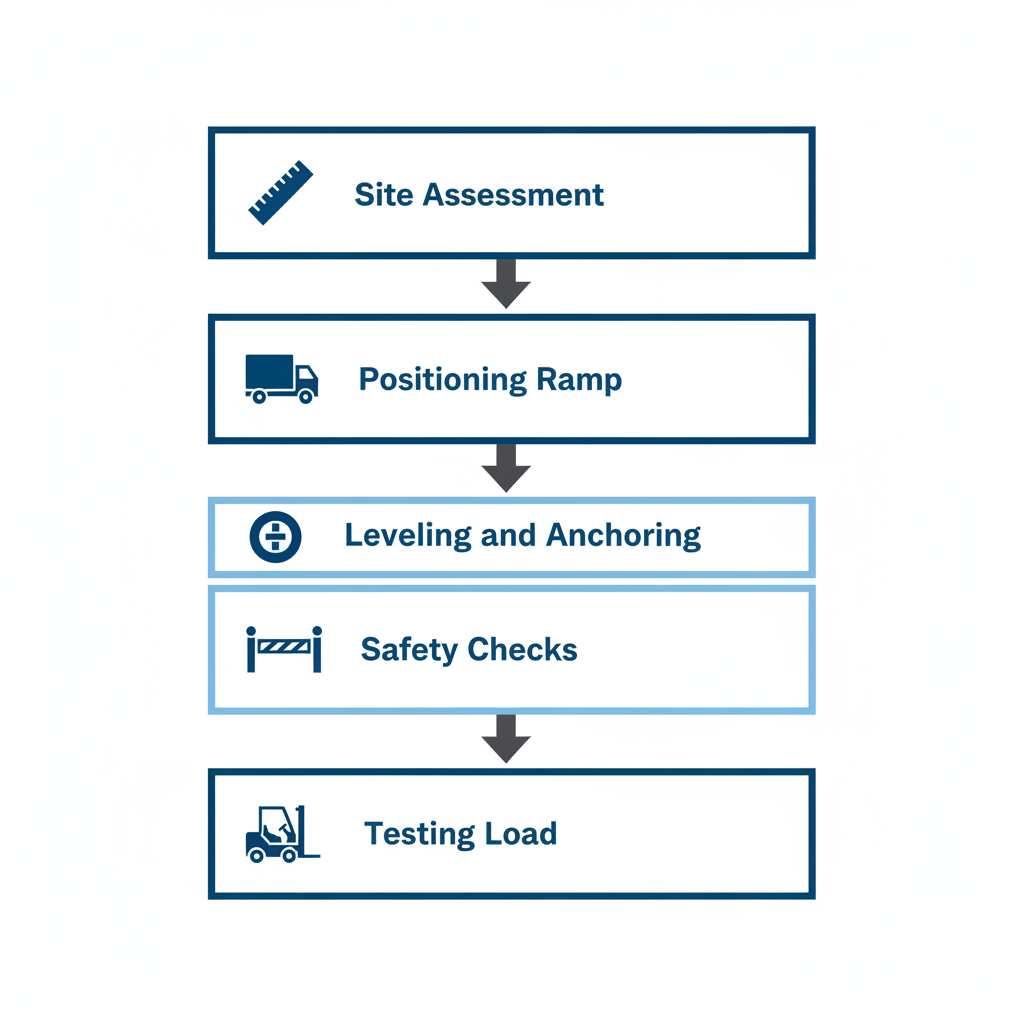
Step-by-step installation process for dock ramps
Following installation, maintenance ensures ongoing reliability. We recommend quarterly inspections for weld integrity and lubrication of moving parts on industrial access platforms. A simple checklist includes: checking for corrosion, verifying bolt tightness, and testing hydraulic functions. For advanced care, schedule professional servicing annually to address wear from heavy use. Avoid overloading, as capacities are site-specific; always follow manufacturer guidelines for repairs.
These practices not only comply with safety norms but also minimize downtime, supporting efficient operations in demanding environments.
Real-World Use Cases in Industry
Ground to dock ramps prove invaluable in high-volume settings. At Amazon fulfillment centers, loading dock ramps facilitate rapid pallet transfers, boosting throughput by enabling ground-level access without permanent dock modifications. Their scalable designs handle diverse truck sizes, aligning with e-commerce demands.
In aerospace, SpaceX employs custom ground to dock ramps for loading components onto transport vehicles, ensuring precise handling of sensitive equipment. These installations feature reinforced capacities up to 25,000 pounds, demonstrating adaptability for specialized manufacturing. Warehousing examples further illustrate versatility, where portable options reduce setup times during peak seasons. Overall, such applications underscore our commitment to tailored solutions that enhance productivity across industries.
Advanced Considerations for Dock Ramps
When facilities demand more than standard solutions, advanced options elevate operational efficiency in demanding environments. Our commitment to excellence, backed by 35 years in the material handling industry, ensures we deliver tailored ground level dock ramps that address unique challenges. These specialized loading solutions integrate seamlessly with existing infrastructure, supporting high-volume operations across the United States.
Customization forms the cornerstone of advanced dock ramp applications, particularly for sites with uneven terrain or specific load requirements. Standard models offer quick deployment but lack flexibility for complex layouts, whereas custom designs adapt precisely to site conditions. For instance, a ground level dock ramp can be engineered with variable heights and widths to accommodate irregular ground surfaces, ensuring stable transitions in advanced US manufacturing plants. This level of personalization, informed by client specifications, contrasts sharply with off-the-shelf options. The following table highlights key differences between custom and standard ground to dock ramps, drawing from MHI production data on lead times and adaptability.
| Characteristic | Standard Ramp | Custom Designed Ramp |
|---|---|---|
| Lead Time | 1-2 Weeks | 4-8 Weeks |
| Site Adaptability | Moderate | Excellent |
As shown, custom models require additional time but provide superior site-specific tailoring, which is essential for long-term reliability. In one case study, we customized a ramp system for a distribution center, reducing setup errors by aligning with existing dock heights and preventing costly retrofits.
Integration with complementary equipment further enhances functionality, especially in dynamic loading scenarios. Our dock to ground ramp configurations pair effortlessly with forklift extensions and guard rails, creating a cohesive safety perimeter around loading zones. For example, integrating portable loading docks allows for temporary setups in multi-bay facilities, while guard rails add fall protection during high-traffic shifts. These combinations, supported by MHI insights on material handling advancements, optimize workflow in warehousing and logistics. Rental-to-own programs offer flexibility, enabling enterprises to test integrations before full commitment, with terms subject to approval.
Looking ahead, trends in ground to dock ramp technology emphasize sustainability and scalability for enterprise clients like SpaceX. Advanced dock bridges incorporate non-slip surfaces and sensor-based monitoring to boost safety, addressing queries on capacity ratings that often exceed 20,000 pounds without exceeding published limits–consult us for site-specific validation. MHI reports highlight automated integrations as a future standard, future-proofing facilities against evolving demands. Key advanced features include:
- Enhanced non-slip treads for all-weather use
- Modular designs for easy expansion
- Eco-friendly materials reducing environmental impact
These innovations ensure our solutions scale with growing operations, covering the entire USA one customer at a time through our multiple manufacturing centers.
Frequently Asked Questions on Dock Ramps
Q: What are the benefits of using a ground level dock ramp in a warehouse?
A: Ground level dock ramps provide safe, efficient access for loading and unloading, serving as a dock leveler alternative. They minimize forklift maneuvering risks, improve workflow, and comply with OSHA standards for ground-to-dock operations, enhancing overall productivity.
Q: How do I size a dock to ground ramp for my needs?
A: Consider your forklift load capacity, door height, and frequency of use. We recommend ramps with at least 20,000-pound capacities for standard applications, ensuring stable transitions without exceeding rated limits.
Q: Can ground to dock ramps be used outdoors?
A: Yes, our durable models withstand weather exposure. Reference OSHA 1917.124 for safety guidelines, and opt for portable combos with rust-resistant finishes for reliable long-term performance.
Q: Are rentals available for dock to ground ramps?
A: Absolutely, we offer flexible short- and long-term rental options, including rent-to-own programs, tailored to your operational timeline without long-term commitments.
Key Takeaways on Ground Level Dock Ramps
Ground level dock ramps enhance loading efficiency and safety in warehousing operations. These dock to ground ramp solutions facilitate seamless transitions, reducing injury risks and boosting productivity. Key selection criteria include capacity ratings, material durability, and compliance with ANSI standards for reliable performance.
We offer flexible rental options for ground to dock ramp needs, ensuring cost-effective access without long-term commitments. As leaders with over 35 years in material handling, we invite you to consult our experts for custom solutions tailored to your facility. For alternatives, explore dock boards vs dock plates to optimize your setup.