

Table of Contents
Essentials of Truck Loading Ramps
In today’s fast-paced warehousing and distribution environments, a Loading Ramp plays a vital role in ensuring safe and efficient operations. Truck loading ramps serve as essential platforms that bridge the height difference between ground level and truck beds, providing seamless access for forklifts to load and unload goods. At Medlin Ramps, with our 35 years in the Material Handling Industry, we specialize in manufacturing heavy-duty solutions tailored for industries like manufacturing, shipping, and retail logistics. Our commitment to excellence is serving the USA, one customer at a time, through innovative designs that eliminate the need for fixed dock infrastructure.
These yard ramps find common applications in ground-level facilities where traditional loading docks are absent, such as smaller distribution centers or remote sites. Portable loading ramps, for instance, offer flexibility for varying truck heights and locations, enhancing forklift access ramps for smoother material handling. Key benefits include significantly improved loading speeds–reducing turnaround times by up to 50% in some operations–and minimized injury risks by promoting stable load positioning, as emphasized in OSHA guidelines on powered industrial trucks and load composition. We cover the entire USA with our multiple facilities in California, New Mexico, North Carolina, and Florida, enabling faster delivery and lower costs. Our product range features elite and stock series yard ramps, constructed from durable carbon steel with test-certified capacities up to 20,000 lbs, alongside rental and rent-to-own options for flexible needs.
As a trusted U.S.-based provider, we align with MHI industry standards to deliver reliable mobile loading platforms that boost operational efficiency. But what makes a ramp effective? Let’s explore the basics in the sections ahead, covering fundamentals, safety considerations, and selection best practices.
Fundamentals of Truck Loading Ramps
At Medlin Ramps, we specialize in engineering robust solutions for efficient material handling, and a truck loading ramp forms the backbone of seamless ground-level loading operations. These essential devices bridge the gap between ground level and truck beds, enabling safe and swift transfers of goods using forklifts. By understanding the fundamentals of a truck loading ramp, warehouse managers and logistics professionals can optimize their facilities for productivity and compliance.
The anatomy of a typical truck loading ramp includes several key components designed for durability and functionality. The main platform provides a stable surface for forklifts to drive onto, often featuring an arched design to accommodate tire clearance and prevent bottoming out. Support legs, either fixed or adjustable, ensure secure positioning, while the surface is textured for traction. A crank system allows for height adjustments, typically ranging from 3 to 5 feet to match various truck heights. This structure, known as a forklift bridge ramp, facilitates smooth transitions in environments without permanent docks.
Mechanics play a crucial role in how these ramps operate reliably under load. The adjustment mechanism, such as our innovative 2-speed crank system, enables operators to raise or lower the ramp quickly and with minimal effort, switching between high-speed coarse adjustments and fine-tuning for precision. As forklifts traverse the ramp, the arched surface distributes weight evenly, maintaining stability even on uneven terrain. We incorporate weather-resistant features like galvanized coatings to withstand outdoor exposure, ensuring consistent performance in rain or snow. These mechanics not only improve loading efficiency by reducing transition times but also answer common queries about how yard ramps enhance warehouse workflows by minimizing manual labor and forklift maneuvering challenges.
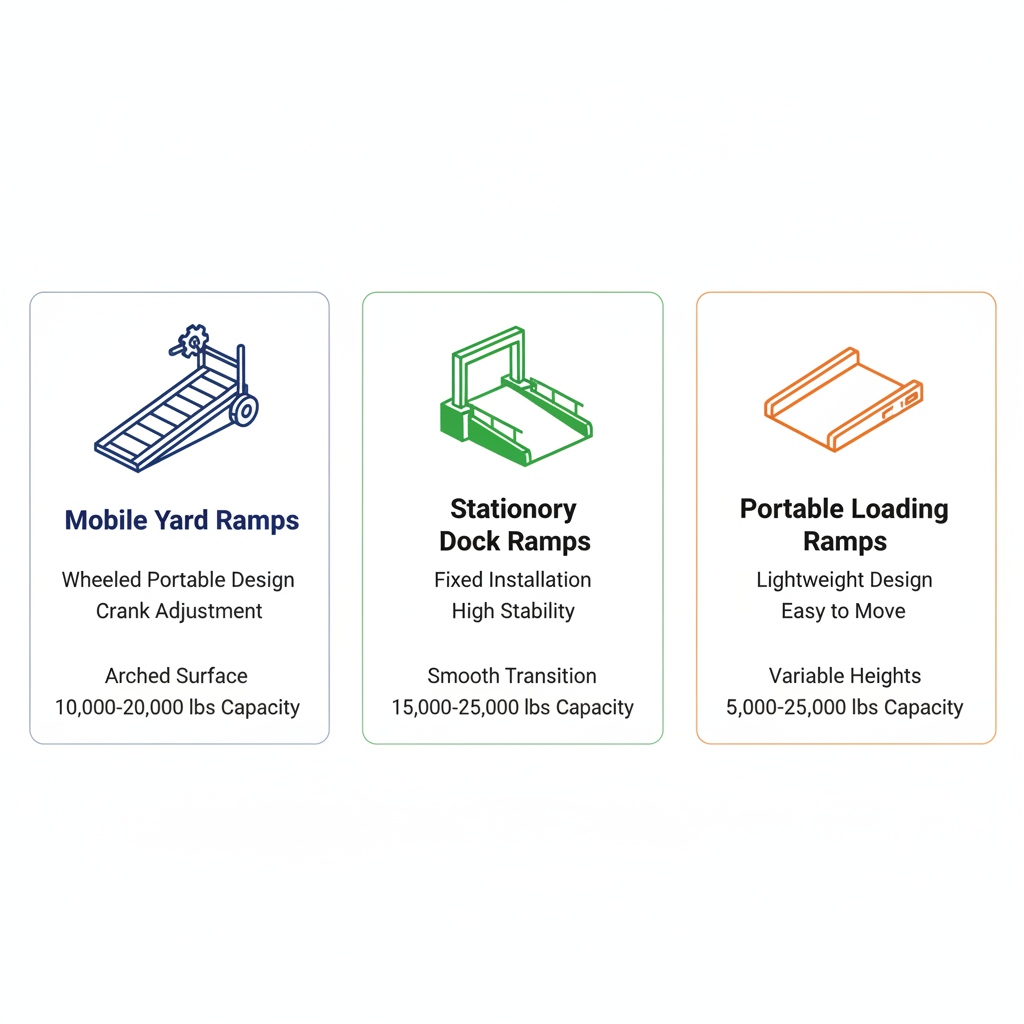
Comparison of three basic truck loading ramp types and their key features
Materials selection is paramount for longevity in demanding industrial settings. Our ramps are constructed from heavy-duty carbon steel, prized for its superior strength-to-weight ratio and resistance to deformation under heavy loads. This material outperforms alternatives like aluminum in high-impact scenarios, providing the resilience needed for repeated forklift traffic. Carbon steel’s natural corrosion resistance, enhanced by protective finishes, makes it ideal for industrial loading platforms exposed to moisture and chemicals, aligning with OSHA guidelines for safe, long-lasting equipment.
Standard specifications ensure these ramps meet rigorous operational demands. Load capacities typically start at 10,000 lbs, supporting everything from palletized goods to heavy machinery. For detailed insights, consult our yard ramps guide.
- Height adjustment: 3-5 feet via manual or hydraulic means
- Grade compliance: Maximum 12% slope per OSHA standards to prevent tip-overs
- Surface width: 60-84 inches for standard forklift access
- Mobility options: Wheeled for portability or bolted for stationary use
When selecting a ramp type, consider your facility’s mobility needs; for instance, dynamic operations may favor portable designs over fixed ones for flexibility.
| Type | Key Features | Ideal Use Case | Capacity Range |
|---|---|---|---|
| Mobile Yard Ramps | Portable, wheeled design with crank adjustment, arched surface for forklift tires | Warehouses without docks | 10,000-20,000 lbs |
| Stationary Dock Ramps | Fixed installation, higher stability, smooth transition to dock | Permanent loading areas | 15,000-25,000 lbs |
| Portable Loading Ramps | Lightweight, easy to move, variable heights via legs or hydraulics | Temporary or multi-site use | 5,000-15,000 lbs |
This comparison highlights trade-offs between mobility and stability, allowing operations to match capacities to specific throughput requirements while adhering to safety grades. Yard ramps, for example, offer versatile capacities suited to mid-sized loads in distribution centers.
Do not exceed rated capacities–consult the manufacturer for site-specific load and installation requirements. Now that we understand the fundamentals, let us examine advanced aspects like capacity and safety.
In-Depth Analysis of Truck Loading Ramp Features
At Medlin Ramps, we specialize in engineering robust solutions for efficient material handling in demanding environments. This section provides a detailed examination of key features in our truck loading ramps, focusing on capacity ratings, integrated safety measures, and pricing considerations. By understanding these elements, operations in distribution and manufacturing can optimize loading processes while prioritizing worker safety and cost-effectiveness.
Capacity and Load Handling
Truck loading ramps must support substantial weights to accommodate diverse truck types and cargo volumes safely. Our designs range from 10,000 lbs for lighter applications to 25,000 lbs for heavy-duty needs, ensuring compatibility with standard forklifts and pallet jacks. These capacities are rigorously tested to maintain stability, particularly important for load centers that affect forklift performance as outlined in OSHA guidelines on powered industrial trucks.
For instance, when handling loads with a center of gravity beyond the standard 24-inch load center, operators must adjust capacities to prevent tipovers, drawing from load moment calculations where weight and distance from the pivot point are critical factors. We incorporate test certifications in our ramps to verify performance under real-world conditions, including uneven surfaces common in yard operations. This approach allows facilities to match ramp specifications to their specific truck fleets, whether box trucks or semi-trailers.
Selecting the right capacity begins with assessing daily throughput and load compositions. Facilities processing high volumes of palletized goods benefit from ramps engineered for balanced weight distribution, reducing risks associated with irregular shapes or oversized items.
The following table compares capacities and features across our ramp models to highlight options for various operational scales:
| Model Type | Max Capacity | Surface Material | Adjustment Mechanism |
|---|---|---|---|
| Elite Mobile Yard Ramps | 20,000 lbs | Carbon Steel | 2-Speed Manual Crank |
| Stock Series Yard Ramps | 15,000 lbs | Carbon Steel | Standard Crank |
| Stationary Dock Ramps | 25,000 lbs | Heavy-Duty Steel | Fixed or Hydraulic |
| Portable Loading Ramps | 10,000 lbs | Aluminum/Steel Hybrid | Leg Adjustments |
Elite Mobile Yard Ramps offer versatile heavy-load access for dynamic sites, while Stationary Dock Ramps excel in fixed installations requiring maximum strength. According to OSHA load composition data, maintaining the combined center of gravity within the forklift’s stability triangle is essential, and our stock series yard ramps provide reliable support for mid-range capacities without compromising mobility.
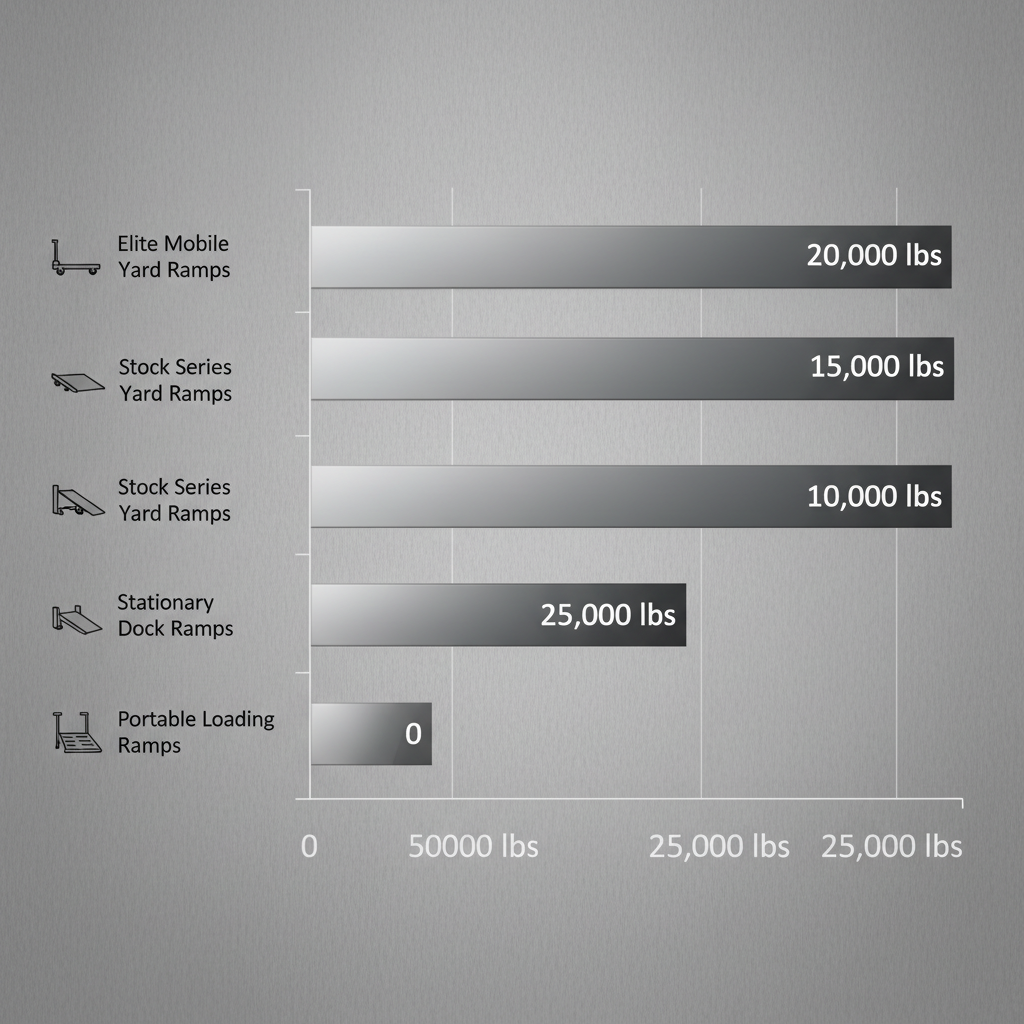
Comparison of truck loading ramp model capacities in lbs
Safety Mechanisms and Standards
Safety remains paramount in our ramp designs, integrating features that align with OSHA standards to protect workers during loading operations. Essential elements include anti-slip surfaces textured for traction under wet or oily conditions and sturdy guardrails to prevent falls from elevated platforms. These mechanisms enhance stability for secure loading bridges, particularly when interfacing with forklift attachments.
OSHA guidelines on attachments emphasize training for operators to manage changes in center of gravity and reduced visibility, ensuring ramps support safe load handling without exceeding rated capacities. Our engineering incorporates forgiving angles and reinforced edges to minimize tipover risks, compliant with powered industrial truck regulations that mandate proper load positioning at low heights.
Cost Factors for Different Models
Investing in quality truck loading ramps involves balancing upfront expenses with long-term value, with our models priced from $5,000 for basic portable loading ramps to over $20,000 for customized stationary units. Material choices significantly influence costs; carbon steel options offer durability at a moderate price, while heavy-duty steel or hybrid constructions add premiums for enhanced corrosion resistance and weight support in harsh climates.
We cover the entire USA with 35 years in the material handling industry, ensuring competitive pricing and swift service from our multiple facilities.
Practical Applications of Truck Loading Ramps
At Medlin Ramps, we understand the demands of fast-paced logistics and warehousing environments. Our solutions, including mobile yard ramps, help businesses streamline operations across the United States.
Enhancing Efficiency in Operations
Truck loading ramps play a vital role in modern supply chains by accelerating pallet transfers and minimizing equipment idle time. In high-volume settings like distribution centers, these operational loading aids allow forklifts to access truck beds directly, cutting loading cycles by up to 50% compared to manual methods.
Integration with Forklifts and Attachments
Integrating portable loading ramps with forklifts requires attention to compatibility for safe, seamless performance. Our forklift extensions pair effectively with truck loading ramps, extending reach into deeper trailers while maintaining load stability. Operators should ensure attachments align with the ramp’s weight capacity, typically up to 20,000 pounds for heavy-duty models.
Advanced Considerations for Truck Loading Ramps
When operations demand more than standard solutions, we turn to advanced configurations that address unique challenges in high-volume or specialized environments. At Medlin Ramps, our expertise allows us to deliver customized truck loading ramps tailored for irregular site conditions.
Customizations for Unique Needs
Custom builds form the cornerstone of sophisticated ramp solutions, allowing adjustments for specific heights, widths, and load requirements. For instance, we engineer specialized industrial ramps with reinforced steel to handle non-standard truck beds, incorporating features like extended lips or adjustable angles.
Integrations and Accessories
Advanced loading systems often require seamless integrations, such as combining portable loading ramps with guardrails and man baskets for elevated access.
- Guardrails and Barriers: Bolster perimeter safety around ramp edges, ideal for high-traffic zones.
- Man Baskets: Facilitate personnel lifting with certified enclosures, compliant for maintenance tasks.
- Order Picker Platforms: Enhance reach for elevated picking, integrated directly onto forklifts.
Common Questions on Truck Loading Ramps
With over 35 years in the Material Handling Industry, we at Medlin Ramps address common queries to help you select the right loading solutions.
Q: What is a truck loading ramp?
A: A truck loading ramp is a sturdy platform that bridges ground level to truck beds, enabling efficient loading and unloading without fixed docks.
Q: What are typical ramp capacities?
A: Our yard ramps handle 10,000 to 25,000 lbs, but always verify load center and distribution for stability, as per OSHA guidelines on forklift safety.
Q: What safety features are essential for these ramps?
A: Essential features include OSHA-compliant railings, non-slip surfaces, and secure locking mechanisms to prevent tip-overs and ensure operator protection.
Q: How do yard ramps compare to fixed docks?
A: Yard ramps offer portability and flexibility for varying truck heights, boosting efficiency by over 30%, while fixed docks provide permanent access but require infrastructure.
Q: Can forklift extensions be used with portable loading ramps?
A: Yes, our portable loading ramps pair seamlessly with forklift extensions for extended reach, maintaining stability within the forklift’s rated capacity.
Q: What is the best portable option for semi-trailers?
A: For semi-trailers, consider our Freight Loading Ramp, designed for heavy-duty access with customizable heights.
Q: How much do these ramps cost, and what are rental options?
A: Portable models start at $5,000; stationary ones are higher. We offer rentals and rent-to-own programs across the USA–contact us for details.
Optimizing Operations with Truck Loading Ramps
In summary, truck loading ramps provide essential fundamentals in capacities and safety features to streamline commercial loading processes across U.S. industries. As members of the MHI Industry Groups, we recognize their industry-wide adoption for reliable performance.