

Table of Contents
Understanding Portable Temporary Docks
In today’s fast-paced industrial landscape, a Portable Temporary Dock serves as a vital innovation for efficient loading and unloading operations. These mobile solutions eliminate the need for permanent infrastructure, allowing businesses to adapt quickly to varying demands in warehousing and distribution. At Medlin Ramps, with over 35 years in the Material Handling Industry, we provide robust options that streamline workflows and reduce downtime.
A portable loading dock is essentially a self-contained unit featuring an integrated ramp for seamless forklift access, ideal for temporary sites or space-limited facilities. We offer models such as the Temporary Loading Dock Ramp. These systems support capacities from 10,000 to 40,000 pounds, ensuring safe handling in dynamic environments. By aligning with OSHA guidelines for hazard reduction in materials handling–as outlined in their Warehousing Hazards and Solutions–we help mitigate risks like slips and ergonomic strains, promoting safer operations without the high costs of fixed installations.
The benefits extend to flexibility for seasonal peaks, such as in retail logistics where companies deploy mobile loading docks during holiday rushes to manage surging volumes cost-effectively. Our portable dock and ramp combos offer rental, purchase, and rent-to-own programs tailored to diverse needs in manufacturing and agribusiness. This mobility outperforms traditional fixed docks in installation speed and adaptability across the US.
As we explore the fundamentals next, this guide will delve into specifications, safety features, and customization options to equip you with comprehensive insights for optimizing your facility’s efficiency.
Fundamentals of Portable Temporary Docks
In the fast-paced world of warehousing and logistics, businesses often face the challenge of loading and unloading goods without permanent infrastructure. A Temporary Loading Docks provides a flexible solution, enabling efficient operations in temporary sites or expanding facilities. With over 35 years in the material handling industry as the largest yard ramp manufacturer in the US, we design these units to meet diverse industrial needs, ensuring safe and reliable performance.
Key Components and Specifications
Portable temporary docks consist of essential elements engineered for durability and ease of use. The primary deck, typically constructed from heavy-duty galvanized carbon steel, forms a stable platform for forklift traffic. An integrated ramp allows seamless vehicle access, while adjustable leveling legs ensure a secure fit on uneven ground. Safety rails surround the perimeter, complying with OSHA Standard 1910.26 requirements for fall protection, and non-slip surfaces prevent accidents during operations.
Key specifications include:
- Capacity Ratings: From 12,000 to 40,000 lbs, compatible with standard forklifts; we recommend not exceeding rated capacities and consulting for site-specific needs.
- Dimensions: Decks measuring 6-10 feet wide by 8-12 feet long, with ramp lengths up to 30 feet for optimal incline.
- Materials: Galvanized steel for corrosion resistance, supporting long-term use in harsh environments.
- Safety Features: Edge guards, locking mechanisms on rails, and high-visibility markings to align with industry standards from MHI guidelines.
These relocatable loading platforms offer an interim dock solution for short-term projects, with rental options available to suit varying budgets and timelines.
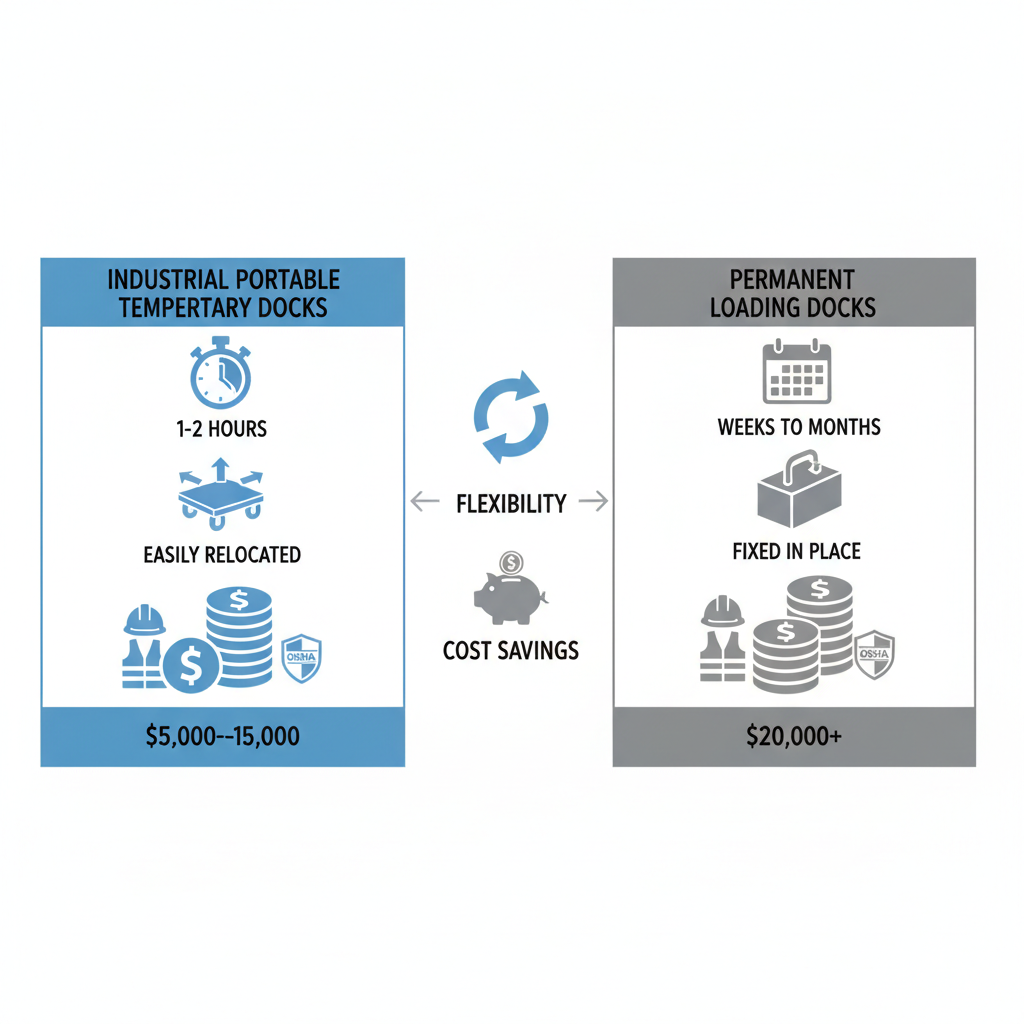
The following table provides a basic comparison between portable temporary docks and permanent loading docks, highlighting key differences in installation, mobility, and cost for introductory understanding.
| Feature | Portable Temporary Dock | Permanent Loading Dock |
|---|---|---|
| Installation Time | 1-2 hours | Requires construction (weeks/months) |
| Mobility | Easily relocated | Fixed in place |
| Initial Cost | $5,000-$15,000 | $20,000+ |
This overview, drawn from industry standards, illustrates the trade-offs: portable options prioritize speed and flexibility for dynamic sites, while permanent docks suit fixed, high-volume operations. Portability reduces upfront investment and downtime, making it ideal for warehouses adapting to layout changes or seasonal demands. However, permanent structures offer greater longevity for established facilities.
Beyond initial setup, portable temporary docks excel in versatility. For instance, anchoring involves simple bolting or weighting to comply with safety protocols, allowing quick deployment in distribution centers across the US. As a mobile loading dock, it facilitates smooth transitions between ground and trailer levels, minimizing forklift strain and enhancing workflow efficiency. Operators appreciate the non-slip deck and rail systems, which meet OSHA 1910.26 for secure edges and visibility.
Comparison of portable and permanent loading docks for industrial efficiency
We cover the entire USA, one customer at a time, with our commitment to excellence in serving industrial needs. These docks benefit warehouses by enabling rapid adaptability–relocating units in hours to accommodate shifting inventory zones or temporary expansions. Rental programs provide cost-effective access without long-term commitments, supporting agility in logistics and manufacturing. Ultimately, investing in a portable loading dock streamlines operations while prioritizing safety and compliance, setting the stage for customized installations explored later.
Exploring Portable Temporary Dock Features
Portable temporary docks represent a vital innovation in industrial materials handling, offering flexibility for dynamic loading environments such as shipping yards and manufacturing facilities. These portable docks enable seamless transitions between ground level and truck beds, reducing downtime and enhancing operational efficiency. Our designs prioritize durability and safety, drawing on decades of expertise to support heavy-duty applications across the United States.
Key Design Elements and Safety Standards
In industrial settings where safety is paramount, the engineering of a portable temporary dock begins with robust structural components that withstand rigorous use. Heavy-duty steel forms the core deck construction, reinforced to handle repeated impacts from forklifts and pallet jacks. Anti-slip coatings on the surface prevent accidents during wet or oily conditions, aligning with OSHA recommendations for non-slip surfaces in materials handling areas.
Key safety integrations include OSHA-compliant guardrails that stand at least 42 inches high to prevent falls, as outlined in warehousing hazard solutions. Wheel chocks secure vehicles during loading, minimizing the risk of movement that could lead to MSDs from unstable operations. These elements ensure compliance with OSHA Standard 1926.250, which mandates secure rigging and materials handling to avoid collapses or shifts under load. For instance, our docks incorporate interlocking designs that distribute weight evenly, reducing the chance of structural failure in high-traffic zones.
To illustrate, consider a manufacturing facility using our modular loading unit for temporary setups; the adaptable dock platform integrates wheel chocks and rails to safeguard workers, directly addressing forklift-related hazards by requiring pre-operation stability checks. This approach not only meets but exceeds basic safety thresholds, promoting a secure workflow.
When selecting a portable temporary dock, factors like site variability and load frequency guide the choice between standard and customized models. The following table outlines key differences:
| Model Type | Standard Portable Dock | Customized Combo |
|---|---|---|
| Capacity Range | 12,000-25,000 lbs | Up to 40,000 lbs (Tailored) |
| Safety Features | Basic rails, non-slip | Advanced rails, custom guards |
| Deployment Time | Under 1 hour | 1-2 hours (site-specific) |
Capacity and Customization Options
Our portable loading docks boast impressive load ratings, typically ranging from 12,000 to 25,000 pounds for standard models, with options extending to 40,000 pounds or more through tailored engineering. This capacity supports even load distribution across the deck, preventing stress points during forklift operations and aligning with OSHA 1926.250 requirements for not exceeding maximum safe loads in storage and handling. For heavy machinery access, such as in recycling or agribusiness sites, we design decks with reinforced beams to manage concentrated weights without deformation.
Customization allows us to adapt each mobile loading dock to precise industrial needs, including adjustable heights from 36 to 60 inches and widths up to 96 inches for wide-load compatibility. Add-ons like forklift extensions integrate seamlessly, providing ramps for elevated access and complying with securement rules from OSHA standards. We also incorporate yard ramp pairings for versatile ground-to-dock transitions in temporary setups, ensuring smooth material flow in construction or distribution environments. Maintenance features, such as corrosion-resistant finishes, promote longevity with minimal upkeep, backed by our 35 years in the material handling industry.
These options deliver tangible benefits, from faster deployment in multi-site operations to reduced injury risks through ergonomic alignments. In shipping facilities, for example, a customized adaptable dock platform with integrated rails cuts loading times by stabilizing vehicles, as supported by OSHA’s emphasis on unsupported passageways and proper equipment use.
The table below compares capacity ratings against common use cases:
| Aspect | Rental | Purchase |
|---|---|---|
| Upfront Cost | Low (deposits) | Higher initial ($5k+) |
| Flexibility | Short-term ideal | Long-term ownership |
| Maintenance | Provider handles | Owner responsible |
Higher capacities enable handling of substantial machinery, optimizing workflows while adhering to load limits and fostering safer, more efficient sites across our nationwide network.
Practical Applications of Portable Temporary Docks
Portable temporary docks offer versatile solutions for industrial environments requiring flexible loading and unloading capabilities. These systems enhance operational efficiency in settings such as distribution centers and construction sites, where permanent infrastructure may not be feasible. We at Medlin Ramps specialize in providing durable options that meet rigorous safety standards, ensuring seamless integration into your workflow.
Installation and Setup Processes
Deploying a portable dock ramps system begins with careful planning to guarantee stability and compliance. The process typically takes 1-2 hours for a standard unit, depending on site conditions and team size. Following OSHA Standard 1910.26, we emphasize secure anchoring to prevent movement during use, which is critical for worker safety in dynamic industrial areas.
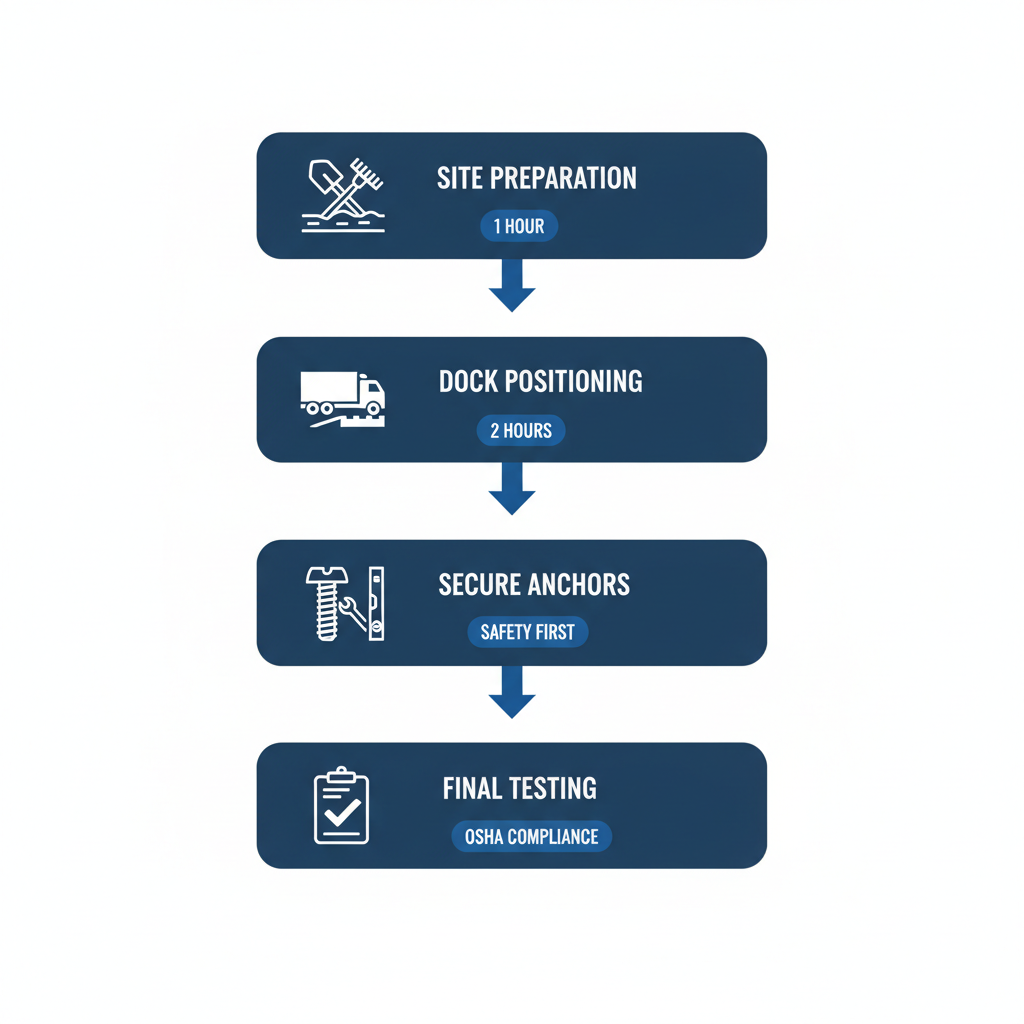
To guide you through the setup, here is a step-by-step process:
- Site Preparation (20-30 minutes): Assess the ground for levelness using a spirit level or laser tool. Clear debris and ensure the surface can support the dock’s weight, typically up to 20,000 pounds. For uneven terrain, use shims or gravel to create a stable base, aligning with OSHA 1926.250 guidelines for material handling in construction zones.
- Positioning the Dock (15-20 minutes): Maneuver the Portable Temporary Dock into place using a forklift or team lift. Align it parallel to the loading area, leaving adequate space for truck maneuvering–about 10 feet on each side. Position the dock at a height matching standard truck beds, around 48 inches, to facilitate smooth transitions.
- Securing with Anchors (20-30 minutes): Attach heavy-duty anchors or bolts to the dock’s base, driving them into the ground or concrete as per manufacturer specifications. We recommend using at least four anchor points for added stability, especially in high-wind areas. This step complies with OSHA securement requirements to avoid sliding or tipping.
- Testing and Final Adjustments (10-15 minutes): Conduct a load test with incremental weights to verify stability. Check for any wobbles and adjust as needed. Walk the surface to ensure even weight distribution and inspect all components for damage.
The following table outlines key decision factors for renting versus purchasing portable docks, helping you choose based on project duration and budget:
| Feature | Standard Model | Heavy-Duty Model |
|---|---|---|
| Load Capacity | Up to 25,000 lbs | 40,000+ lbs |
| Materials | Carbon steel | Reinforced alloys |
| Customization | Basic options | Full bespoke |
Step-by-step installation guide for portable temporary docks in industrial settings
Use Cases in Warehousing and Logistics
In warehousing, portable loading docks transform underutilized spaces into functional loading zones. For instance, during peak holiday seasons at distribution centers, companies deploy these units to handle increased truck traffic without altering permanent structures. A real-world example involves a logistics firm in a major U.S. hub expanding temporarily; the portable loading dock enabled quick access for unloading pallets, cutting wait times by up to 30% as per MHI efficiency benchmarks.
Construction sites benefit similarly, where mobile loading docks support material delivery amid ongoing builds. On a commercial project, workers used the deployable loading station to bridge ground-to-truck gaps, complying with OSHA 1926.250 by maintaining clear aisles and secure stacking. This setup prevented delays from uneven terrain, streamlining forklift operations and reducing injury risks from manual handling.
Another scenario arises in expanding facilities, such as recycling operations adding temporary lines. Here, the portable temporary dock facilitates safe transfer of bulky items, optimizing space without costly renovations. Our clients in agribusiness have reported smoother harvests by positioning these docks near silos, aligning with MHI data on improved throughput in variable environments.
Advanced Considerations for Portable Temporary Docks
When implementing portable temporary docks in demanding environments like manufacturing and recycling facilities, advanced customization plays a pivotal role. Our custom solutions often combine these docks with guard rails or man baskets to enhance safety during loading operations. For instance, a Portable Temporary Dock integrated with ergonomic man baskets allows workers to handle materials at optimal heights, reducing strain and aligning with OSHA guidelines for preventing musculoskeletal disorders. We also offer specialized loading modules that incorporate forklift extensions and options like dock boards vs dock plates, ensuring seamless connectivity for powered industrial trucks. These integrations address site-specific needs, such as uneven terrain or high-volume throughput, drawing from our 35 years in the material handling industry.
In heavy industry settings across the USA, considerations for docks extend beyond basic setups to include robust safety features. Our engineering teams at distribution centers in California, New Mexico, North Carolina, and Florida collaborate to design these combos, providing nationwide coverage with faster delivery times. This approach not only meets regulatory compliance but also supports efficient operations in temporary sites.
Moving to cost analyses, purchasing a portable loading dock typically ranges from $5,000 to $20,000, depending on capacity and features, while rentals start at around $200 per week for short-term needs. These investments yield strong ROI through minimized downtime; for example, a well-integrated dock can accelerate loading cycles by 30 percent in recycling operations, based on streamlined materials handling practices recommended by OSHA. Rental options, including rent-to-own programs, offer flexibility for seasonal demands without large upfront costs. We emphasize site-specific evaluations to ensure capacities align with actual loads–do not exceed rated capacities, and consult our experts for installation requirements.
Frequently Asked Questions on Portable Temporary Docks
What are the benefits of using a portable temporary dock for loading operations?
Portability enables quick relocation, reducing setup costs and downtime compared to fixed structures. We offer mobility that saves up to 50% on infrastructure expenses.
How long does installation take?
Typical setup for our portable loading dock requires just 1-2 hours with minimal tools, ideal for temporary sites.
Are rentals available for portable temporary docks?
Yes, we provide short-term rental programs for mobile loading docks, with flexible terms to suit project needs.
What capacity options exist?
Options range from 10,000 to 40,000 lbs, supporting heavy-duty applications across industries.
How do portable temporary docks compare to permanent ones?
They offer faster deployment and lower initial costs, though permanent docks provide long-term durability for high-volume use.
What safety features are included in mobile loading docks?
Features like non-slip surfaces and guardrails ensure compliance with OSHA 1910.26 standards. Pair with dock boards for secure transitions.
Portable loading dock vs. yard ramp: key differences?
Docks elevate directly to truck beds for seamless access, while yard ramps suit ground-level loading but require more space.
Optimizing Operations with Portable Temporary Docks
Portable Temporary Docks offer industrial facilities a streamlined path to enhanced efficiency, combining quick installation with high load capacities to support diverse loading needs. At Medlin Ramps, we prioritize these versatile solutions to boost operational flexibility and safety without the demands of permanent structures. Our designs accommodate heavy-duty applications, ensuring reliable performance across US facilities.
Key takeaways include the adaptability of portable loading docks for temporary projects and the security they provide in dynamic environments. These mobile loading docks enable seamless transitions between setups, minimizing downtime and optimizing workflows.