

Table of Contents
Loading Dock Ramps: A Comprehensive Guide
In busy warehouses across the US, forklifts often face challenges accessing loading docks without proper infrastructure, leading to delays and safety hazards. According to OSHA guidelines on loading dock safety, forklift accidents at docks contribute to thousands of injuries annually, underscoring the need for reliable solutions. We at Medlin Ramps, with over 35 years in the material handling industry, understand these pain points and provide robust loading dock ramps to streamline operations.
A Loading Dock Ramp serves as a fixed or portable structure that bridges the gap between ground level and the dock, enabling safe forklift access for loading and unloading. This differs from yard ramps, which facilitate ground-to-ground transfers in outdoor areas. Standard models support capacities up to 25,000 lbs, as outlined in OSHA Standard 1910.26, ensuring compliance with regulatory requirements for dock equipment. Our durable carbon steel designs enhance workflow efficiency while minimizing injury risks through stable dock access ramps.
Portable options offer flexibility for varying warehouse loading platforms, including rental programs for short-term needs. Explore our comprehensive loading dock ramps guide for insights on installation, selection factors, dock levelers, and dock boards. These elements collectively optimize safety and productivity in logistics settings.
Understanding Loading Dock Ramps and Key Components
At Medlin Ramps, we specialize in heavy-duty solutions for warehouse operations, including stationary loading dock ramps designed for seamless ground-to-dock access. These ramps play a crucial role in facilitating efficient material handling in US warehouses, ensuring safe and reliable loading processes. Understanding their fundamentals helps businesses select equipment that aligns with operational needs and safety standards.
Differences from Yard Ramps
Loading dock ramps differ significantly from yard ramps in structure and function, primarily due to their fixed integration with loading docks versus the mobility of yard ramps. A loading dock ramp provides elevated access directly from ground level to the dock height, often permanently attached or semi-permanent for consistent use in enclosed or semi-enclosed warehouse environments. In contrast, yard ramps offer flexible ground-to-ground bridging in open areas, allowing forklifts to load trailers without dock infrastructure. This distinction is vital for warehouse layout planning, as loading dock ramps support high-volume, fixed-position operations, while yard ramps enhance versatility in dynamic yards.
The following table compares key features of loading dock ramps and yard ramps to clarify these differences:
| Feature | Loading Dock Ramp | Yard Ramp |
|---|---|---|
| Primary Use | Ground-to-dock elevation for fixed loading areas | Ground-to-ground access in open yards |
| Mobility | Typically stationary or portable dock-integrated | Highly mobile with wheels for repositioning |
These distinctions matter for warehouse layout because selecting the wrong type can lead to inefficiencies or safety risks. For instance, a loading dock ramp optimizes space in permanent loading zones, reducing setup time for daily shipments. According to ANSI MH30.1-2022 standards for dock leveling devices, proper installation ensures structural integrity, which is essential for both types but more rigid for dock-integrated setups.
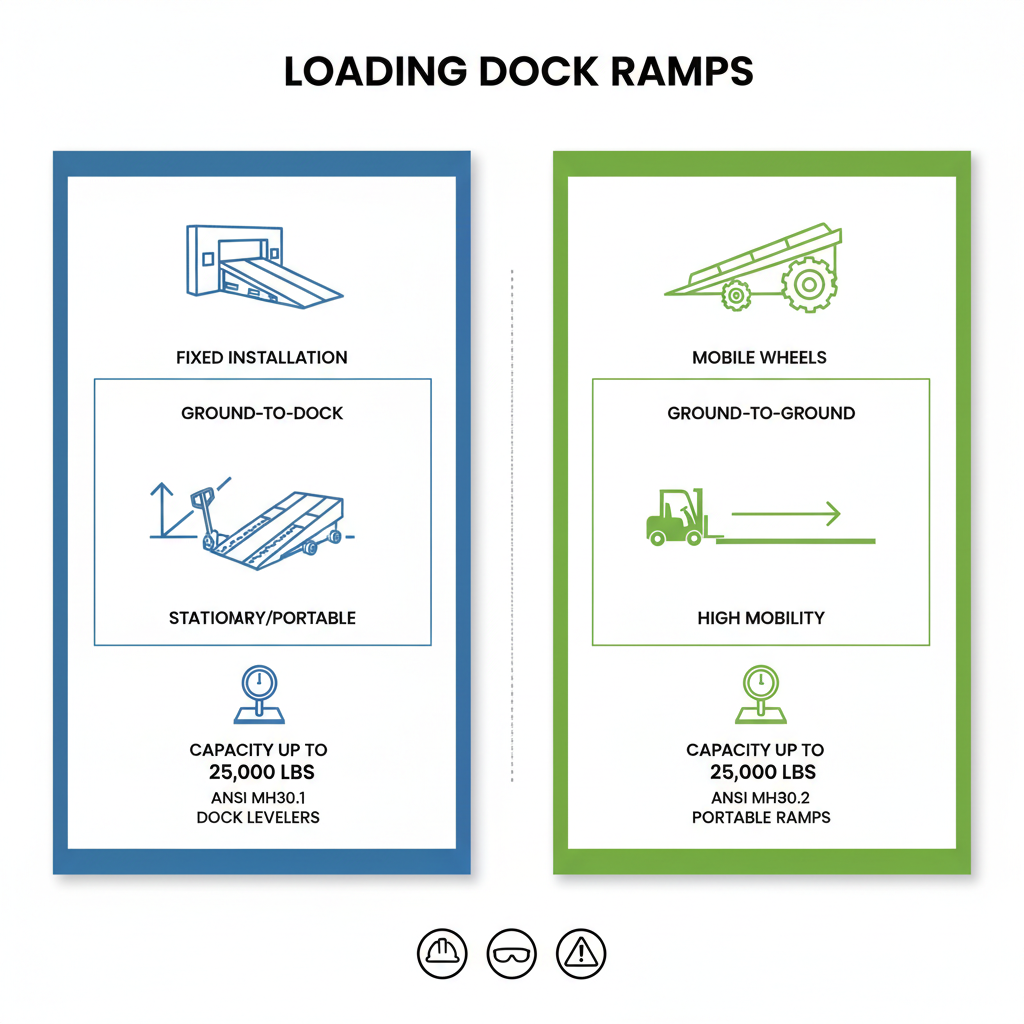
Side-by-side comparison of loading dock ramps and yard ramps key features
This infographic underscores how Dock Ramp designs from Medlin Ramps integrate durability with functionality, supporting informed decisions for material handling.
Weight Capacities and Standards
Loading dock ramps typically support capacities ranging from 10,000 to 25,000 pounds, depending on design and materials like carbon steel fabrication we use at Medlin Ramps. Factors such as ramp length, width, and incline angle influence these ratings, with steeper angles reducing effective load limits. Safety standards from OSHA and ANSI MH30.1-2022 mandate testing for uniform load distribution to prevent failures under dynamic forklift traffic.
Related Equipment: Dock Levelers and Boards
Dock levelers serve as adjustable platforms that bridge gaps between docks and truck beds, complementing loading dock ramps for precise leveling. Types include hydraulic dock levelers, which use fluid pressure for smooth operation, and mechanical ones that rely on spring-assisted lifts–both outlined in ANSI MH30.1-2022 for capacities up to 30,000 pounds. We recommend hydraulic models for high-traffic sites due to their reliability and ease of use.
Dock boards, or lightweight bridges like aluminum or steel plates, provide portable solutions for minor height adjustments. Aluminum dock boards offer corrosion resistance and easier handling for lighter loads, while steel versions deliver superior strength for heavier applications in shipping docks. Pros of aluminum include portability and non-slip surfaces; cons involve lower weight limits compared to durable steel.
Benefits of Portable Loading Dock Ramps in Warehouses
In dynamic warehouse environments across the US, portable loading dock ramps offer significant advantages for operations. Our Portable Dock Ramp solutions, including ramp-and-dock combos, enhance efficiency and safety while providing flexibility.
Efficiency and Workflow Improvements
- Reduced setup time for irregular truck arrivals
- Enhanced forklift maneuverability with stable inclines
- Cost savings through rental options for seasonal demands
Safety and Injury Prevention
Safety remains paramount in warehousing, where slips, trips, and falls account for a significant portion of injuries, as noted in OSHA’s warehousing hazards solutions. Our designs feature OSHA-compliant features like reinforced edges and high-traction grates, reducing the likelihood of falls from uneven access points.
How Loading Dock Ramps Operate and Integrate
At Medlin Ramps, we design loading dock ramps to facilitate seamless material handling in warehouses and distribution centers across the United States. These essential components bridge the gap between trucks and docks, ensuring efficient loading and unloading.
Installation and Setup Processes
- Conduct a site assessment to evaluate dock height, floor strength, and traffic flow.
- Position the ramp parallel to the dock, adjusting height with hydraulic lifts or manual cranks.
- Secure anchoring points, ensuring all fasteners meet load capacity requirements.
- Test stability by applying gradual weight, simulating forklift operations.
- Integrate with existing dock systems, verifying clearance for equipment.
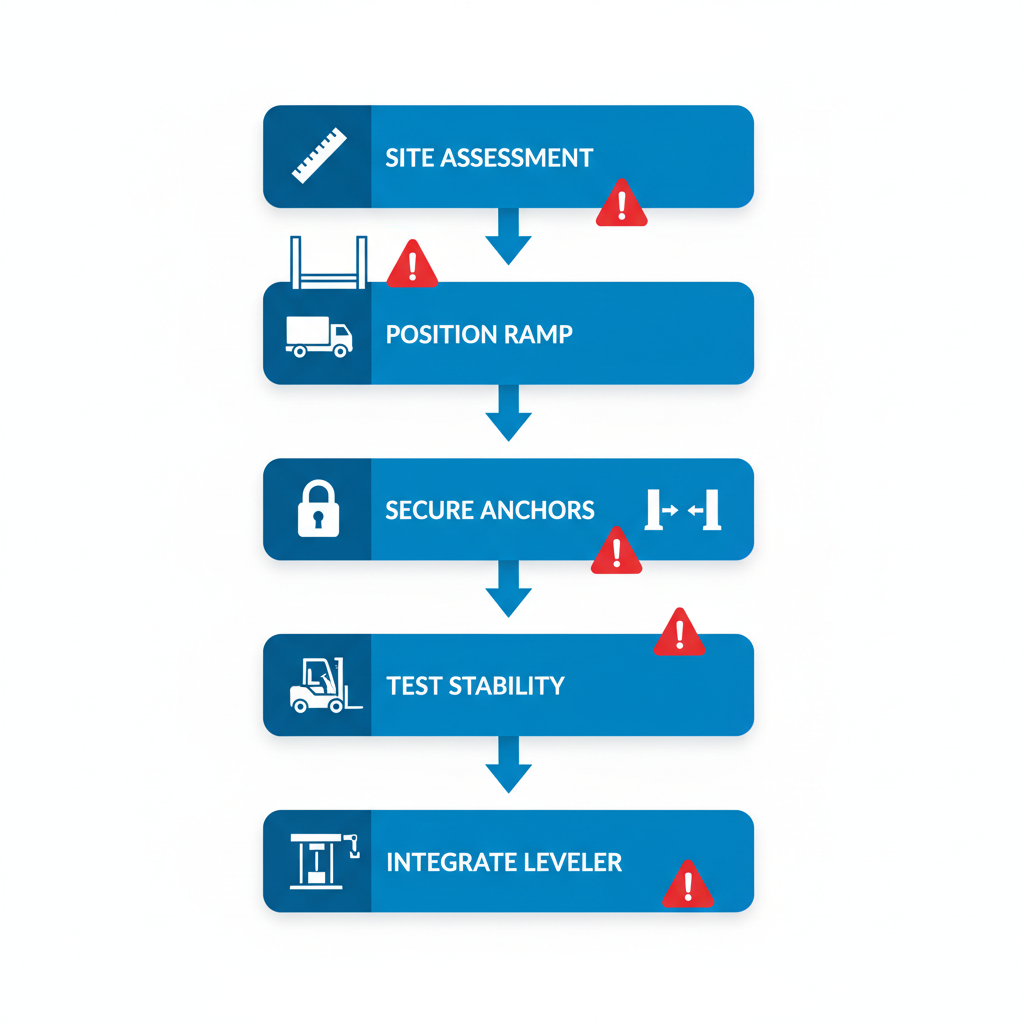
Step-by-step installation process for portable loading dock ramps
Functionality with Forklifts and Equipment
| Aspect | Hydraulic | Mechanical |
|---|---|---|
| Operation | Powered fluid pressure | Manual or spring-assisted |
| Cost | Higher initial | Lower upfront |
Best Practices for Selecting and Using Loading Dock Ramps
Selection Criteria for Heavy-Duty Applications
When choosing a Loading Dock Ramp for heavy-duty use, we recommend evaluating capacity, material choice, and incline. Steel offers superior durability for high-impact environments, while aluminum provides corrosion resistance. Ensure you align these criteria with standards like OSHA 1910.26.
Optimizing with Dock Boards and Levelers
To maximize dock efficiency, strategically pair loading dock ramps with dock levelers and dock boards for seamless ground-to-dock transitions. For enhanced performance, consider dock boards vs dock plates based on your bridging needs.
| Property | Aluminum | Steel |
|---|---|---|
| Weight | Lightweight | Heavier but durable |
| Cost | Higher per capacity | More economical |
Optimizing Warehouse Operations with Loading Dock Ramps
In today’s fast-paced logistics landscape, a reliable Loading Dock Ramp stands as a cornerstone for enhancing warehouse efficiency and worker safety. Investing in durable, customizable options promises sustained productivity gains across US facilities. We invite you to explore our rentals and custom combos, including stock series yard ramps.